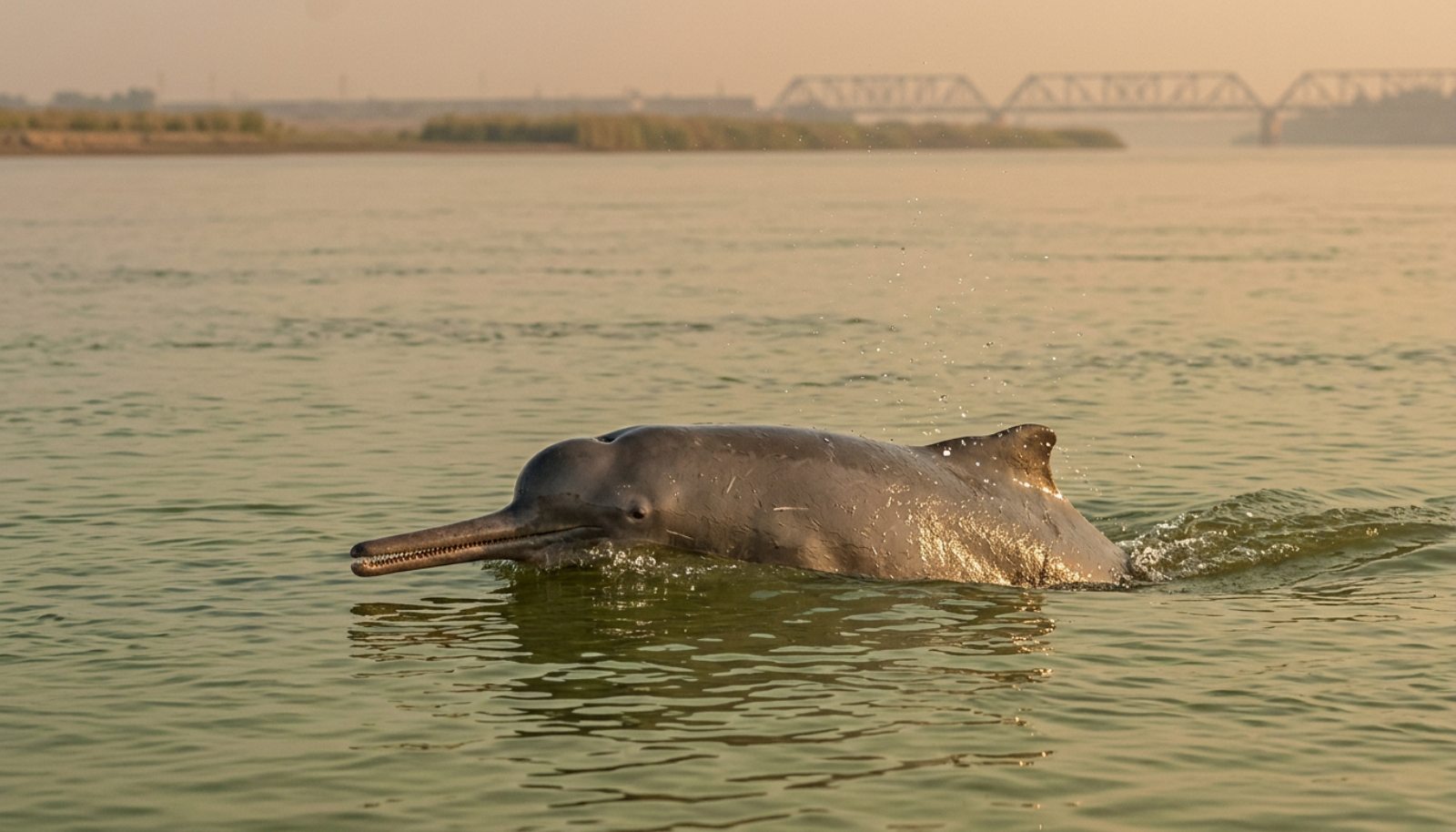
Short answer: The Indus River dolphin (Platanista minor), known in Sindh as the bhulan, is an endangered freshwater dolphin found only in Pakistan’s Indus basin. About 2,000 remain. The most reliable place to see one is the Indus Dolphin Reserve between Sukkur Barrage and Guddu Barrage, usually on a boat trip arranged from Sukkur.
Last updated: 10 November 2026
Few large wild animals live inside a working irrigation system. The Indus River dolphin does. It shares the river with barrages, canals, pumps, fishing boats and millions of people, and it finds its way through water so thick with silt that eyes are nearly useless. Sukkur marks the southern edge of its stronghold. The city’s barrage, completed in 1932, is the downstream boundary of the Indus Dolphin Reserve, a protected stretch of roughly 190 kilometres that runs upstream toward Guddu.
In this guide: what the species is · why it is blind · how barrages shape its range · population in 2026 · threats · conservation · where to see it · getting to Sukkur
Quick facts at a glance
| Fact | Detail |
|---|---|
| Scientific name | Platanista minor Owen, 1853; recognised as a separate species in 2021 |
| Local name | Bhulan (Sindhi); Indus blind dolphin |
| IUCN status | Endangered (A2abcde; C1), assessed 2021 |
| Population | About 2,000; 1,816 counted in the 2021 national survey |
| Range | Indus River, Pakistan; a small relic population in the Beas River, India |
| Size and weight | 2.1 to 2.6 metres; 68 to 91 kilograms |
| Eyes | Tiny and lensless; can detect light and direction, not images |
| Navigation | Echolocation; frequently swims on its side near the riverbed |
| Lifespan | About 30 years; sexual maturity around 9 years |
| Protected areas | Indus Dolphin Reserve (1974; Ramsar site 2001); Punjnad Sanctuary (2026) |
| Best place near Sukkur | Indus Dolphin Reserve, upstream of Sukkur Barrage; Lab-e-Mehran viewpoint in the city |
What is the Indus River dolphin?
The Indus River dolphin is one of two living species in the genus Platanista. Richard Owen described it in 1853 from a skull that was smaller than that of the Ganges dolphin, and for more than a century it was treated as a subspecies. In 2021, a taxonomic revision using genetic and morphological evidence elevated it to a full species, Platanista minor. The IUCN Red List assessed it separately and published an Endangered assessment in 2022.
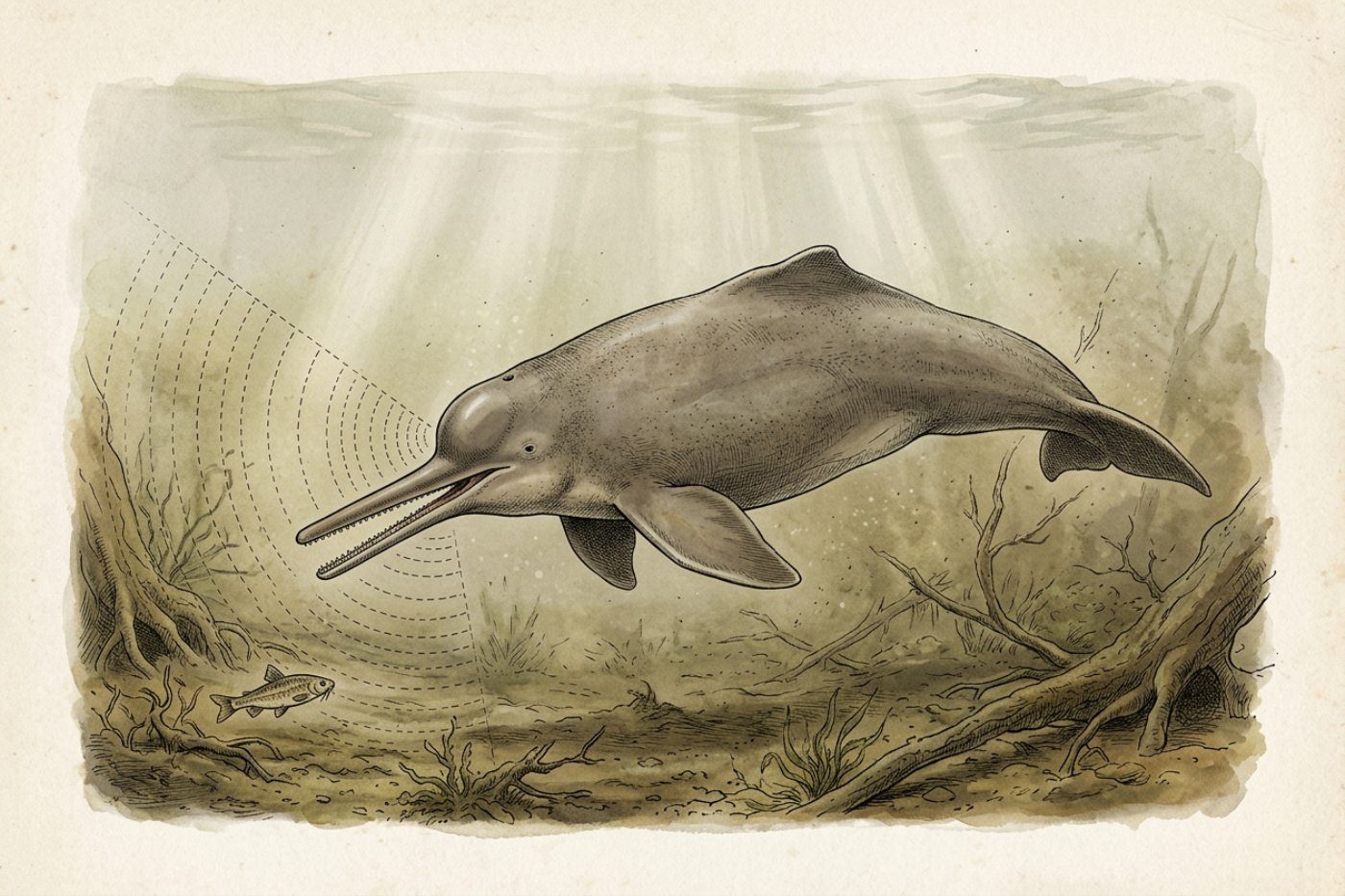
It is a compact animal: adults measure 2.1 to 2.6 metres and weigh 68 to 91 kilograms. The back is grey-brown and the belly is paler, sometimes with a pinkish flush. The beak is long and narrow, lined with sharp, fang-like teeth, and the dorsal fin is a low triangular hump rather than the tall fin of an oceanic dolphin. The body is built for slow water and tight spaces, not for open ocean.
Bhulan feed on fish, clams and shrimp, often close to the riverbed. They reach sexual maturity at about nine years, breed through the year, and after a gestation of eight to ten months give birth to a single calf. Lifespan is about 30 years. The slow reproductive rate is one reason the species recovers gradually and loses ground quickly when adults are killed.
Why is the Indus River dolphin blind?
The eyes are tiny and lack a lens. They can detect the brightness and direction of light, but they cannot form a focused image. In the Indus, this is less a disability than a specialisation. The river carries a heavy load of silt and visibility is measured in centimetres. The dolphin relies on echolocation: it produces a rapid series of clicks, focuses them through the fatty melon in its forehead, and reads the returning echoes to build a picture of the water ahead.
It often swims on its side, trailing one flipper near the bottom and sweeping the riverbed with sound. The habit is characteristic enough that researchers use it to identify the species at a distance. The bhulan is functionally blind, not eyeless, and its hearing is tuned to the frequencies that return best from small prey in shallow, muddy water.
A river cut into rooms: barrages and the 690 km range
The species once ranged through the Indus and its major tributaries. Today it occupies about one-fifth of that historic range, concentrated in roughly 690 kilometres of the main river. The reason is engineering. The Indus is regulated by a chain of barrages: Sukkur, Guddu, Taunsa, Chashma and others. Each is a low dam with gates that divert water into canals. The Sukkur Barrage was built without fish passes, and the chain fragments the river into sections that dolphins cannot freely cross.
The Sukkur Barrage, with its 66 gates, opened in 1932 and is anchored on Bukkur Island. It turned Sukkur into an irrigation capital, but it also closed the southern end of the dolphin’s world. In 1974, Sindh declared the river between Sukkur and Guddu barrages a dolphin reserve; in 2001, the 125,000-hectare site was listed under the Ramsar Convention as site 1065.
Upstream, the same pattern repeats. The Punjnad Indus River Dolphin Sanctuary, declared in June 2026, adds nearly 200 kilometres of protection in Punjab and connects with existing reserves. Together with existing reserves, it brings the protected corridor along the Indus to about 400 kilometres, from the Chashma area down to Sukkur.
How many Indus River dolphins are left?
Counting a dolphin that surfaces for a second in muddy water is difficult. Survey teams work from boats, scan fixed transects and record every surfacing; statistical models then correct for animals missed. The figures below come from different surveys, different coverage and different methods, so they should be read as a trend, not a scoreboard; the 2025 peer-reviewed analysis is the most detailed recent source.
| Year | Estimate | Scope and method | Source |
|---|---|---|---|
| 2001 | 965 | National direct count | IWC survey summary |
| 2006 | 1,410 | National direct count | IWC survey summary |
| 2011 | 1,665 (95% CI 1,499–3,017) | National estimate | Aisha et al. 2025 |
| 2017 | 1,987 (95% CI 1,886–3,552) | National estimate; 19.4% above 2011 | Aisha et al. 2025 |
| 2019 | 1,419 | Sindh survey, Guddu to Sukkur | Mahessar et al. |
| 2021 | 1,816 | National survey | WWF-Pakistan |
| 2026 | About 2,000 | Working figure | WWF and Mongabay |
At the end of the nineteenth century, naturalists estimated about 10,000 animals. Hunting by river communities, then barrages, then nets pushed the population down; by 2001 surveys were counting fewer than 1,000 animals. The creation of the reserve, the end of organised hunting and a rescue programme reversed the decline. The 2021 national survey counted 1,816 animals, and the current working figure is about 2,000.
Two cautions matter. First, a count is not a census: the confidence intervals are wide, and the 2019 figure covers only the Guddu to Sukkur section, so it is not a national total. Second, the species is still Endangered under IUCN criteria and its range is still fragmented. A rising number in a shrinking river is not security.
Threats: nets, water and pollution
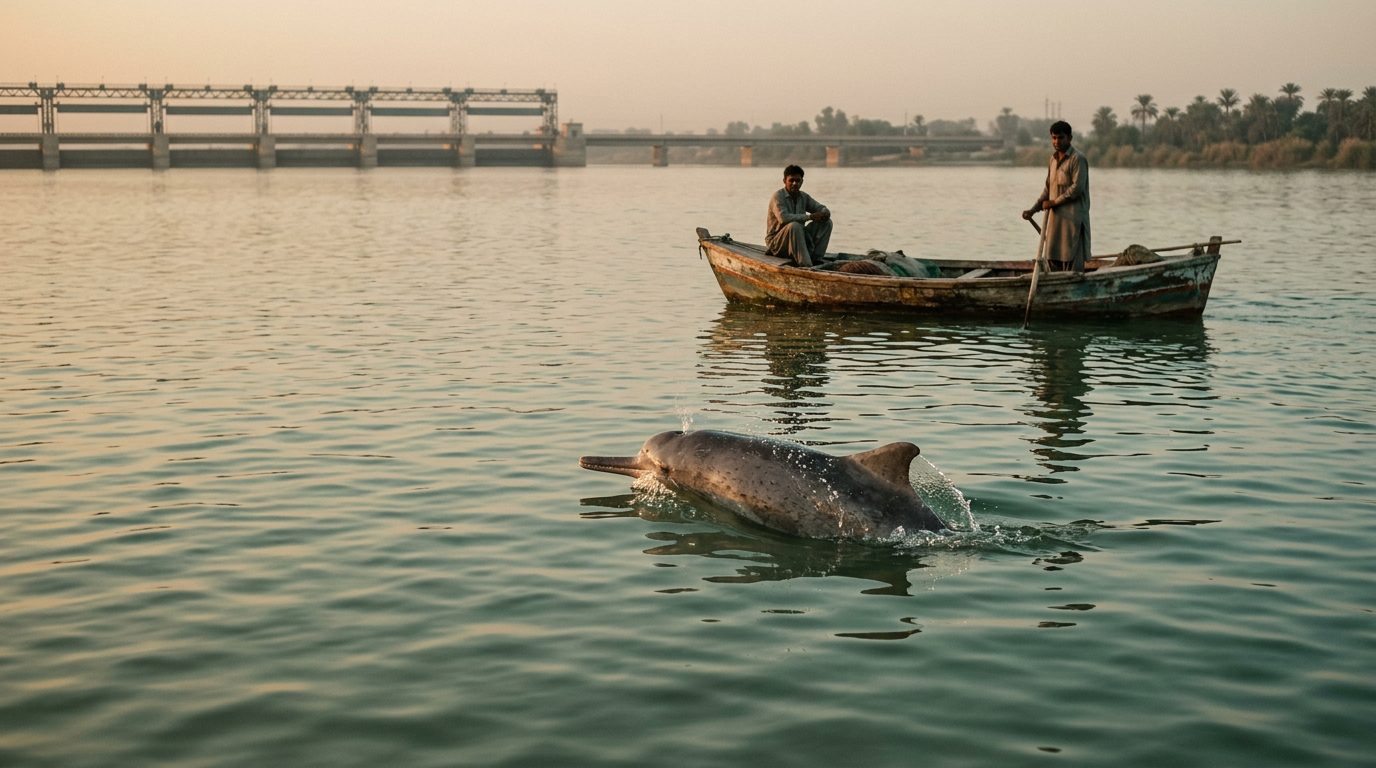
Gillnets are the leading documented killer. A 2026 review found that entanglement accounted for 52% of documented dolphin deaths. The nets are set for fish, including the palla that is a local delicacy; a dolphin that swims into them cannot see the mesh and drowns.
Water abstraction is the slower threat. The barrage canals support millions of acres of irrigated farming, and in dry years the river between barrages can fall to a series of pools. Low water concentrates dolphins, increases conflict with fishermen and makes the animals vulnerable to heat and disease.
Pollution adds another layer: untreated sewage from towns, agricultural runoff and industrial discharges. In parts of the basin, gold mining uses mercury and cyanide, which can enter the food chain. Floods bring their own danger, stranding dolphins in canals and flooded fields; the Sindh Wildlife Department and WWF-Pakistan run a rescue team that translocates stranded animals.
Boat traffic, especially fast-moving vessels, disturbs the animals and can cause injuries. For a dolphin that depends on sound, engine noise is a kind of fog.
Conservation: what is working
Conservation in Sindh is not a single project. It is a set of institutions that have learned to work together. The Sindh Wildlife Protection Ordinance of 1972 gave the species legal protection. The 1974 reserve gave it a place. The Ramsar designation in 2001 gave it international standing. The Sindh Wildlife Department, WWF-Pakistan and local communities now run patrols, rescue stranded animals, monitor populations and promote ecotourism.
The Indus Dolphin Conservation Centre in Sukkur is the city’s base for much of this work. Researchers and staff there can advise on current sightings and on responsible boat operators. The 2026 Punjnad sanctuary extends the same model upstream.
The results are measurable. The population has grown from a few hundred in the 1970s to about 2,000. That is a genuine success, and it is rare among freshwater cetaceans. But the species remains Endangered because its habitat is still fragmented and its future depends on how much water Pakistan leaves in the river.
Where to see Indus River dolphins near Sukkur
The core habitat is the reserve, upstream of Sukkur Barrage. Dolphins are not guaranteed anywhere, but the odds are best in the reserve, especially in the cool months when the water is lower and clearer.
| Option | What it is | Best for | Practical note |
|---|---|---|---|
| Indus Dolphin Reserve (Guddu to Sukkur) | Core protected stretch of about 190 km | Serious wildlife watching | Full-day or overnight boat trip from Sukkur; use a licensed boat and local guide |
| Lab-e-Mehran and Indus Dolphin View Point | Public park on the right bank beside Sukkur Barrage | Families and short stops | Sightings are occasional; early morning is best |
| Indus Dolphin Conservation Centre, Sukkur | Research and interpretation base | Context before a trip | Ask staff for current sightings and operator advice |
| Sadh Belo and Bukkur Island | River heritage sites | Combining wildlife with history | Boat crossings; see the Sadh Belo guide |
For a dedicated trip, plan a full day or an overnight stay. A boat leaves Sukkur and moves upstream; the further you go from the city, the better the habitat. Bring water, sun protection, binoculars and a jacket for the early start. The best light is from first light to mid-morning, and again in the last two hours before sunset.
Lab-e-Mehran is the easy option. The park sits on the right bank of the Indus beside the barrage, and the Indus Dolphin View Point is within the park. Dolphins are sometimes seen from the bank, especially when the river is low. Treat a sighting as a bonus, not a promise.
Wherever you go, follow three rules. Do not feed the dolphins. Do not chase them or cut across their path. Keep the engine slow and give the animals room to breathe. A dolphin that is chased will dive and stay down; a dolphin that is left alone may surface beside the boat.
For photography, a 300mm lens is useful, but patience matters more. Set a fast shutter speed, keep the horizon level and focus on the patch of water where the animal last surfaced. Polarised sunglasses cut glare. Drones are regulated, so check with local authorities before flying.
Getting to Sukkur: a practical guide
Sukkur is the practical base. The city has an airport (SKZ) about 25 to 30 kilometres from the centre, with limited domestic flights; most international visitors connect through Karachi or Islamabad. Rohri Junction, across the river, is on the main Karachi to Lahore railway and is served by long-distance trains. By road, the M-5 and M-9 motorways connect Sukkur with Hyderabad and Karachi, about 470 kilometres away, and with Multan and, further on, Lahore, about 800 kilometres away. Mohenjo-daro is roughly 80 kilometres from the city, making a combined heritage trip possible.
November to February is the comfortable season. Summer temperatures can exceed 45°C, and the monsoon can raise water levels and reduce visibility. Ramadan and the Muharram period bring changes to opening hours and local transport, so check locally. The Sukkur city guide has current hotel, airport and transport details.
International visitors should confirm visa requirements with the Government of Pakistan’s official visa portal before booking. Within Sukkur, ride-hailing is limited; a hired car or a trusted local driver is the simplest way to reach the barrage and the park.
Why this species matters beyond Pakistan
Freshwater dolphins are among the most threatened groups of mammals on Earth. The bhulan is one of the few that has stopped declining. Its survival is a test of whether a heavily engineered river can still support wild megafauna. For Pakistan, the dolphin is also an indicator: where the bhulan is present, the river has enough flow, enough fish and enough oxygen to support a complex food web. The wider river system depends on the same conditions.
For visitors, the appeal is simpler. There are not many places where you can stand on the bank of an irrigation system that feeds millions of people and watch an animal from an ancient lineage finding its way through muddy water by sound. The bhulan is not a relic in a museum. It is still there.
Frequently Asked Questions
How many Indus River dolphins are left?
About 2,000. A national survey in 2021 counted 1,816, and a 2025 analysis of the 2017 survey estimated 1,987. The population has grown since the 1970s, but the species is still classified as Endangered.
Why are Indus River dolphins blind?
Their eyes are tiny and lack a lens. They can sense light and dark but cannot form images. In the silty Indus they navigate and hunt by echolocation, producing clicks and reading the echoes that return.
Where can I see an Indus River dolphin?
The best chance is the Indus Dolphin Reserve between Sukkur and Guddu barrages, on a boat trip arranged in Sukkur. In the city, the Indus Dolphin View Point at Lab-e-Mehran park sometimes offers sightings from the bank. November to February is the best season.
Is the Indus River dolphin the same as the Ganges river dolphin?
No. They are separate species. The Indus dolphin is Platanista minor and the Ganges dolphin is Platanista gangetica. A 2021 taxonomic revision confirmed the split, and the IUCN assessed the Indus species separately.
How big is an Indus River dolphin?
Adults are 2.1 to 2.6 metres long and weigh 68 to 91 kilograms. They are stocky, grey-brown animals with a long narrow beak and a low triangular hump in place of a tall dorsal fin.
What do Indus River dolphins eat?
Fish, clams and shrimp, mostly close to the riverbed. They use echolocation to find prey in water where visibility is almost zero.
Are Indus River dolphins dangerous to humans?
No. They are shy animals and do not attack people. Keep a respectful distance, do not touch or feed them, and follow the boat operator instructions.
What is being done to protect the Indus River dolphin?
Sindh protected the species in 1972 and created the Indus Dolphin Reserve in 1974. The reserve became a Ramsar site in 2001. The Sindh Wildlife Department and WWF-Pakistan run surveys, rescues and ecotourism, and in 2026 Pakistan added the Punjnad sanctuary, creating about 400 kilometres of contiguous protected river.
Sources and further reading
- IUCN Red List: Platanista minor (2022 assessment).
- NOAA Fisheries: Indus River Dolphin (species profile, 2024).
- Aisha et al. (2025), abundance of the Indus River dolphin, Endangered Species Research 58:315–329.
- Mongabay (September 2026): Pakistan expands protected habitat.
- Ramsar Sites Information Service: Indus Dolphin Reserve, site 1065.
- International Whaling Commission: abundance survey summary.
- Braulik et al. (2021), taxonomic revision of Platanista, Marine Mammal Science.
- River Dolphins.org: Indus river dolphin.
Research & Documentation by Rohri.net. Published on Sukkur.net. Original illustrations by Sukkur.net; population figures are cited to the surveys listed above and are not presented as a census.