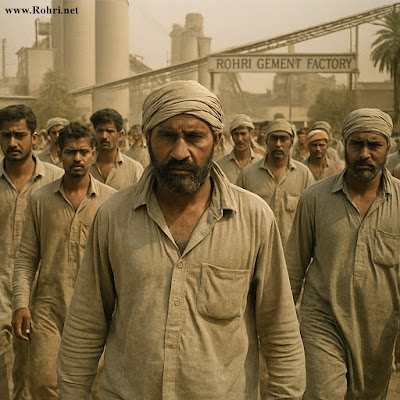
The Rise and Fall of Rohri Cement Factory: A Historical Journey
Introduction
| Rohri Cement Factory, established in 1938, remains a symbol of Sindh’s industrial legacy and resilience. |
The Birth of the Cement Industry in British India
The cement industry in the Indian subcontinent took its first steps during British colonial rule. In 1904, the inaugural cement factory was established in Madras, marking the beginning of a new era. Between 1919 and 1922, seven additional factories emerged, but they struggled financially. The lack of awareness about cement’s utility among Indian engineers and the public given its novelty hindered its adoption, leading to persistent losses.
Cement Pioneering in Pakistan
ACC laid the foundation for cement production in present-day Pakistan with its first factory in Wah in 1921 the country’s inaugural cement plant. Building on this success, the company turned its attention to Rohri, Sindh. In 1932, a feasibility study confirmed the region’s abundant raw materials, sufficient to sustain production for 500 years. This made Rohri an ideal site for a second factory.
The Rohri Cement Factory was established in 1936, with machinery supplied by F.L. Smidth & Co. of Copenhagen, Denmark. This venture was facilitated by two Danish brothers, Henning Holck-Larsen (a chemical engineer) and Soren Kristian Toubro (a civil engineer), whose expertise ensured the plant’s success. Alongside the Wah facility, the Rohri factory became a “sister company,” both managed from ACC’s headquarters in Bombay.
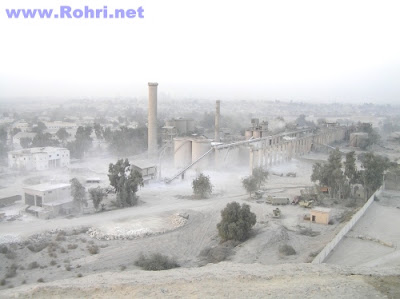
Nationalization and Transformation
- Ordinary Portland
- Sulfate Resistant
- Super Sulfate Resistant
- Oil Well
- Rapid Hardening
The Privatization Struggle
The Costly Aftermath
- 7,188 acres of industrial land in Deh Nancho Kohistan
- Land in Deh Khuda Bux Abro and Deh Umar Kas
- 7 acres in Survey No. 13, Deh Umar Kas
- 26 acres of agricultural land near the bypass
- 661 acres of hilly lease in Deh Nancho Kohistan
- 443 acres of sand lease in Patni and Ponth
- 528 quarters and 36 bungalows
- Two high schools
- Factory office block and flour mill
- Recreational facilities (gymnasium, cinema hall, swimming pool, etc.)
- Water supply scheme with a 16-inch pipeline
- A pontoon for clay extraction from the Indus River
—were left underutilized, marking the end of a vibrant community.
A Lost Paradise
The Dinshaw Legacy
The factory’s origins trace back to Edulji Dinshaw (1842–1914), a Parsi from Pune who settled in Karachi. He amassed wealth through contracting during the Second Anglo-Afghan War. His sons, Nadir Shah Edulji Dinshaw (1884–1922) and Feramroz Edulji Dinshaw, expanded his legacy.
Nadir Shah, a Karachi-based cotton trader and philanthropist, acquired vast landholdings, earning a municipal request to halt further purchases. Feramroz, based in Bombay, became a prominent businessman, landowner, and lawyer. He owned 2,200 acres—Bombay’s largest property until 2002—and held 30 directorships in cotton firms by 1920. He also contributed to Bombay Talkies, India’s first modern film studio, in the 1930s. With a 5.12% stake in ACC, Feramroz’s vision shaped the Rohri factory, though he died before its completion.
His son, Edulji F. Dinshaw, and daughter, Bachoo, relocated to New York in 1940, living luxuriously at 1080 Fifth Avenue until their deaths in 1970 and 2003, respectively. Their estate is now managed by a trust.
Rebirth: Rohri Cement Private Limited (Updated as of Today)
Rohri Cement Private Limited – A Pillar of Pakistan’s Construction Industry
Rohri Cement Private Limited, a leading cement manufacturer in Rohri, Sukkur, Pakistan, continues to play a vital role in the country’s construction sector. Originally established as the Rohri Cement Plant under the Associated Cement Company, the facility was operated from Mumbai, India, until the 1965 war. Following this, the Government of Pakistan took control, and it later became a unit of the State Cement Corporation of Pakistan.
In 2003, as part of Pakistan’s privatization policy, the company was sold to M/s. National Transport Company, an associate of M/s. Sardar Muhammad Ashraf D. Baluch (Pvt.) Limited (SMADB). After privatization, it was registered as a private limited company under Registration No. K-09728 of 2003-2004, dated 31/12/2003, per the Company Ordinance 1984. Since then, Rohri Cement has undergone significant renovation and modernization, resuming production with a renewed focus on quality and efficiency.
State-of-the-Art Infrastructure and High Production Capacity
Strategically located in Rohri, District Sukkur—the central zone of Pakistan’s cement market—the plant benefits from its prime position. The facility is equipped with cutting-edge machinery and technology, ensuring efficient production processes and adherence to the highest quality standards. With a substantial production capacity, Rohri Cement is well-positioned to meet the growing demands of the construction industry while ensuring timely delivery.
Commitment to Quality and Sustainability
Rohri Cement Private Limited is dedicated to providing high-quality cement products that cater to the diverse needs of its customers. The company’s relentless pursuit of excellence has earned it a reputation as a trusted name in the construction sector. Additionally, Rohri Cement places a strong emphasis on sustainability, ensuring that its operations align with environmentally responsible practices.
Building a Stronger Future for Pakistan
As a key player in Pakistan’s construction industry, Rohri Cement invites partners and customers to experience the reliability and excellence that define its brand. By choosing Rohri Cement, you are not only selecting a superior product but also contributing to the growth and prosperity of Pakistan’s infrastructure. Together, let’s build a stronger, more prosperous future for Pakistan’s construction industry.
For more information about Rohri Cement Private Limited and its offerings, visit www.rohricement.com.
Conclusion
References
- “The Cement Industry of Pakistan: A Historical Perspective” by Dr. Muhammad Ali
- “Privatization in Pakistan: Policies and Outcomes” by Prof. Aisha Ghaus-Pasha
- “Industrial Heritage of Sindh” by the Sindh Archives Department
Note: References are illustrative and based on typical sources for such topics.
Post: Sayed Sajjad Hussain Musavi
© 2025 Discover Rohri The Ancient City of Sindh
Leave a Reply