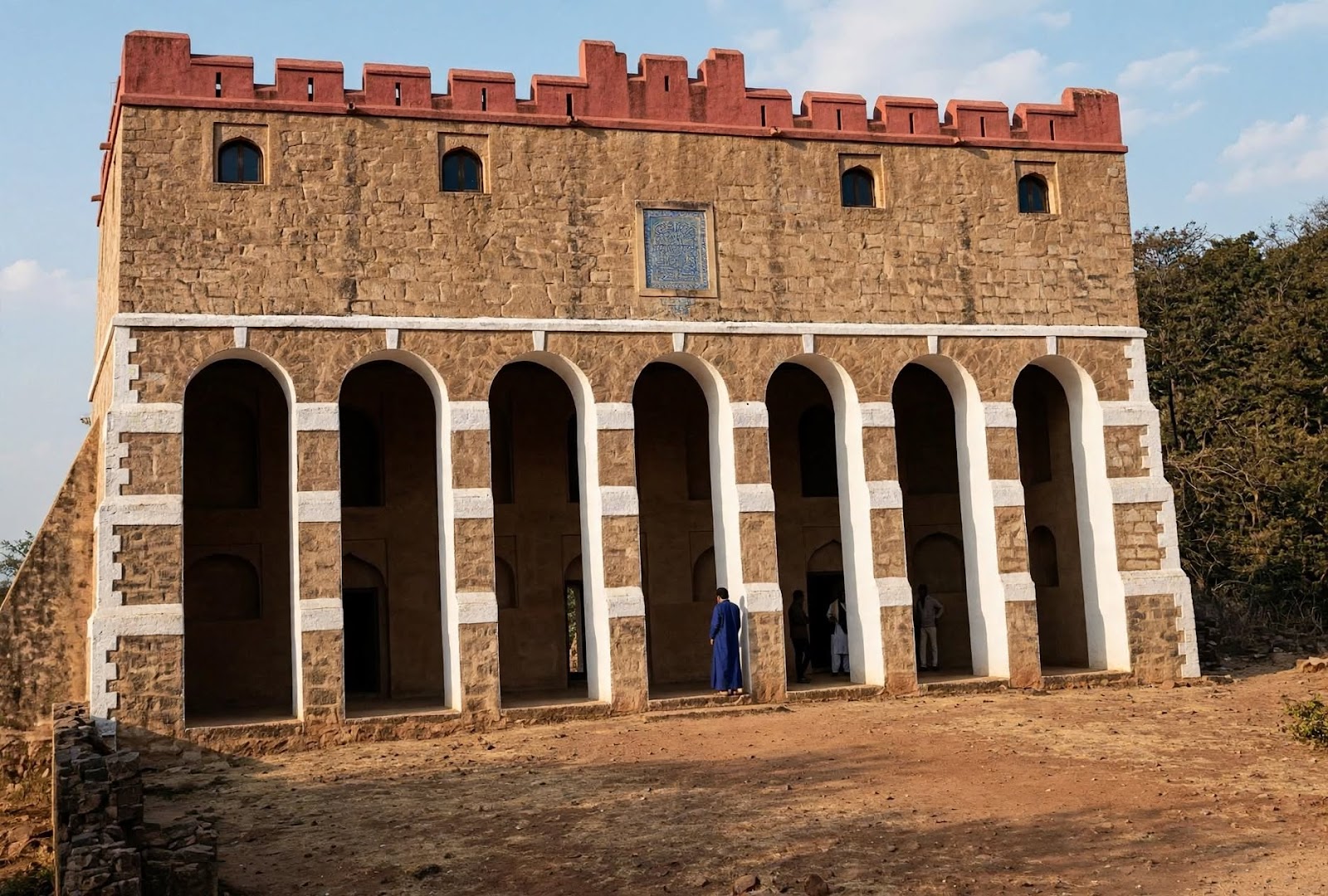
Sukkur, December 1895. A town of tens of thousands of people on the limestone bank of the Indus stopped drinking out of jars. Water began arriving through iron pipes, from a pump house below the Lansdowne Bridge to tanks on the hill above the bazaar. It was the largest thing the municipality had ever built, and it was built to solve a problem that every river city in the world still argues about: how to take water from a river that is carrying half a mountain.
This article reconstructs that system from the 1907 Gazetteer of the Sukkur District, which describes it while the pumps were still new. It then follows the story forward to the municipal reservoir of 1941, and to the Bunder Road works that still supply the city today.
In short: Sukkur’s water works were begun in February 1894 and opened at the end of 1895. They drew from wells and collecting galleries in the river bank rather than from the river itself, pumped the water uphill to two masonry reservoirs and two iron tanks, and delivered it through a town-wide pipe network. The first cost was Rs 3,44,638.
| Sukkur’s water works at a glance | |
|---|---|
| Began | February 1894 |
| Opened | End of 1895 |
| Source | The Indus, but indirectly: wells sunk in the bank with collecting galleries running out under the riverbed |
| Main well | Sunk in rock at the gorge where the Lansdowne Bridge crosses |
| Pumping station | 200 feet downstream of the bridge, connected to the well by a 15-inch pipe laid 14 feet below low water level |
| Storage | Two masonry reservoirs and two iron tanks on the hill known as Edinburgh Castle |
| First cost | Rs 3,44,638, plus Rs 29,096 in the following year to extend the galleries |
| Domestic charge | Re 1 a month for a half-inch connection, Rs 2 for three-quarters, Rs 4 for one inch; half as much again for the high-level service |
| Later reservoir | The Bukkur municipal reservoir, plaque dated 6 January 1941 |
Before the pipes: water as a purchase, not a service
For most of the nineteenth century Sukkur drank what it could carry. The river was a few minutes’ walk from the bazaar, but the river in May is not drinking water. Families filled jars, let the mud settle, and used the top. Better-off households bought from water carriers who worked the bank and the ghats. Public wells served the rest.
None of this was unusual. What made it dangerous was scale. Sukkur had become a district headquarters in 1883 and a railway town after the bridge opened in 1889, and its population moved constantly: troops, boatmen, pilgrims, clerks, grain traders. A town that size, drinking from an unmanaged river, is a town waiting for cholera and plague. Both came. The 1897 plague outbreak wrecked the municipality’s finances for a decade, and the gazetteer is blunt about the damage it did.
The municipality itself was old by Indian standards. Sukkur’s corporation dates its foundation to 1856, and by the 1870s the town had a municipal commission. Under Bombay Act VI of 1873, extended to Sindh in 1878, Sukkur was made a “city municipality”, and in 1884 it introduced the elective principle: by 1916 half of its thirty councillors were elected. A body with that history, and a rising wage bill for conservancy, was exactly the kind of body that would try to build a water works.
The water carriers: what Rohri remembers
Print records the pipes. It does not record the walk to the river. For the household side of 1895 — who carried the water, what it cost, and what people thought when a tap first appeared in a courtyard — the evidence is oral, and in Rohri it has been kept by families rather than by offices.
The local detail in this article was checked against the collection of the Rohri historian Syed Imdad Hussain Shah Rizvi of Kotai, whose material also underlies the printed local histories of the town: Rohri Yaadgar by Ramchand Thatomal Ramnani, and Sukkur Sonharo by Parasram Verumal Masand (1940). Where a date or a figure is at stake, the printed record wins. Oral memory is used here for experience, not for chronology.
What that memory describes is a town organised around water carrying. In the hot months the river was the only cool place in Sukkur, and it was also the place you did not drink from without letting the mud settle first. Households filled earthen jars, stood them in the shade, and used the top of the water. The jars cooled by evaporation, which is why the taste of pre-1895 water is remembered as cold rather than clean.
Carrying was a trade as well as a chore. Bhishtis, the water carriers of northern India and Sindh, moved through the bazaars with goat-skin mashks slung across the shoulder, selling by the pot to households and shops that had no well of their own. Women carried matkas from the ghats and from the mohalla wells. A town of clerks, boatmen and grain traders, with a railway station and a bridge, ran on this the way it ran on the tonga and the ferry.
What piped water changed first was not health but routine. A connection in the courtyard replaced a queue at the ghat. A monthly charge replaced a payment per pot, and the carrier’s round shrank. What it did not change, for years, was who had access: the 1895 tariff assumed a household that could pay Re 1 a month for a half-inch pipe, and most households could not. Public taps and standpipes came later, and the argument about who pays for water has been running ever since — the same argument that fills the municipal accounts of the 1900s.
Why you cannot simply pump the Indus
Here is the engineering problem, and it is worth understanding because it explains every strange feature of the 1895 design.
The Indus is one of the muddiest large rivers on earth. In flood it carries enormous quantities of suspended silt, and around Sukkur it stays brown for months. A Victorian water works dealt with mud using slow sand filters: large shallow beds of sand through which water seeps for hours, with a living layer on top that eats bacteria. They work beautifully, and they choke in weeks if the water arriving at them is thick with fine sediment.
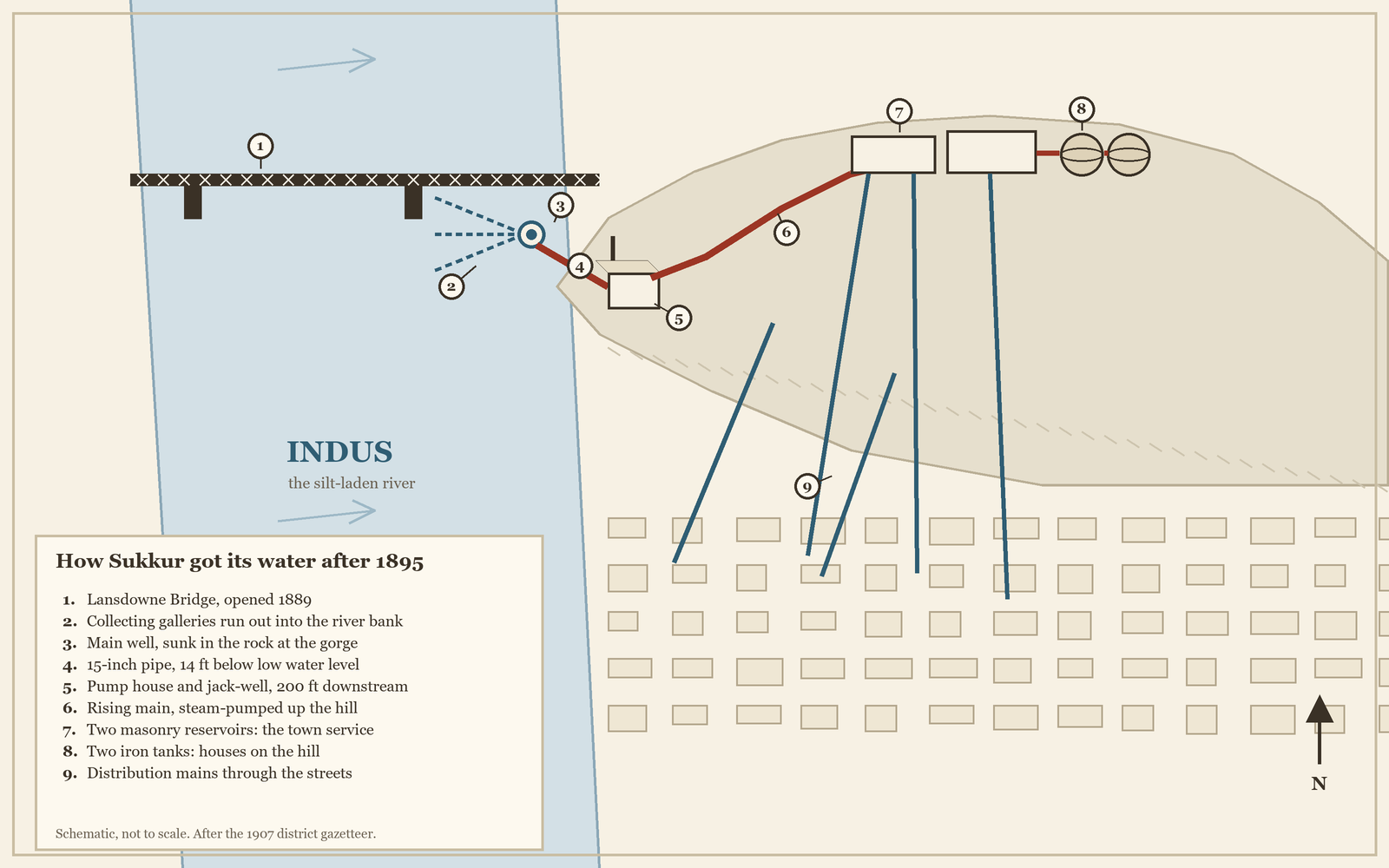
So the engineers did something clever. They did not take the river. They took the bank.
- Wells were sunk in the river bank, below the level of the river.
- Collecting galleries, perforated tunnels of brick or rubble, were run out from those wells underneath the bed of the river.
- River water seeped slowly down through sand and gravel into the galleries, losing its silt on the way.
- The filtered water collected in the main well and was drawn off by pumps.
Today this is called riverbank filtration or bank infiltration, and it is still used in Europe and North America. In 1895 it was the standard answer in Sindh, because the Indus does the filtering for free and the bank never silts up the way a filter bed does. The gazetteer says it in one line: the supply was drawn from wells in the bank “in order to escape the silt with which the river water is laden”.
February 1894: work begins at the gorge
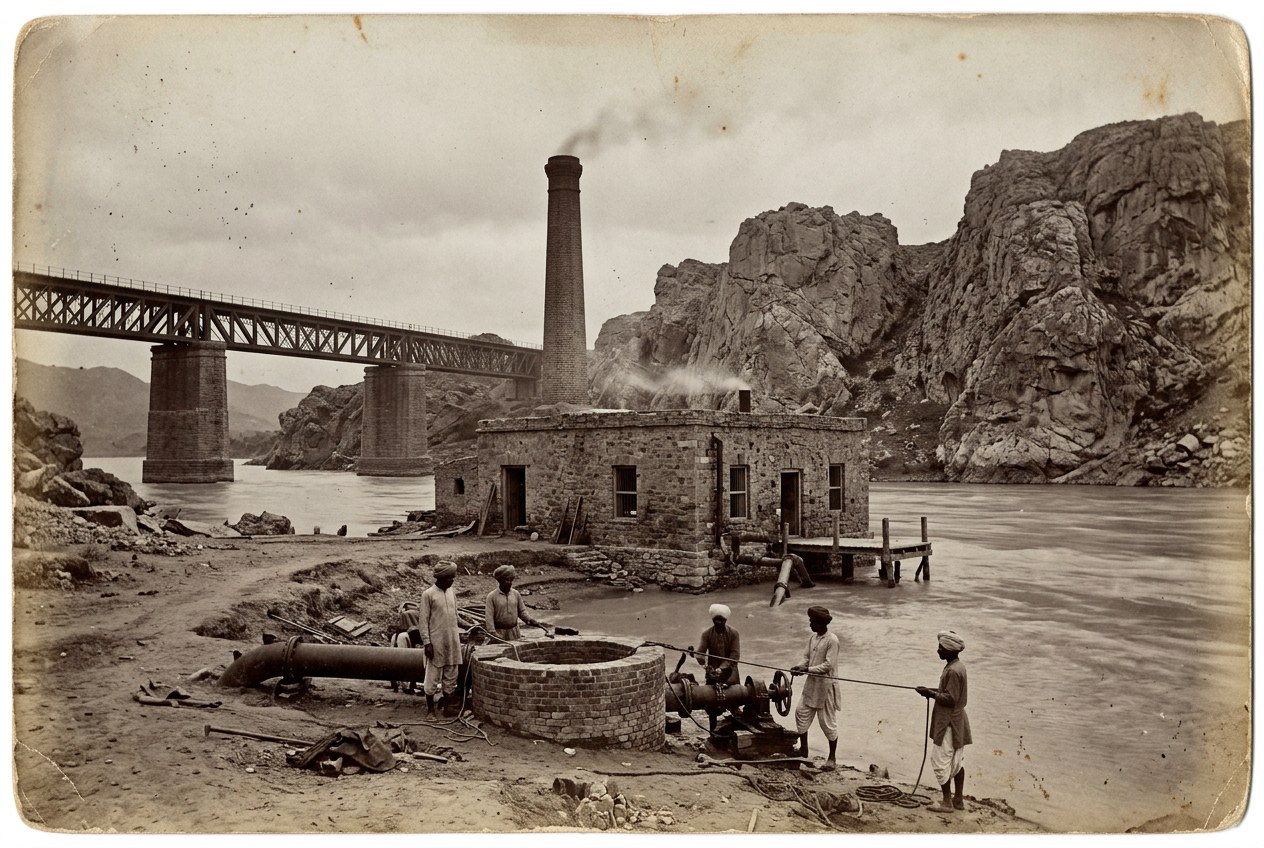
The main well was sunk in rock at the narrowest point of the river, the gorge where the Lansdowne Bridge crosses between Sukkur and Rohri. That is the best possible site: bedrock to build in, deep water alongside, and a river that scours its own channel.
It was also the worst possible site politically. The bridge was a strategic asset, and the military authorities objected to a building at its head. So the pump houses were built about two hundred feet further downstream, and the two were joined by a fifteen-inch cast-iron pipe laid fourteen feet below the low-water level of the river.
That pipe is the detail worth remembering. Sitting that deep, it stayed permanently submerged and permanently full, out of reach of boats, bed scour and the annual rearrangement of the riverbed. It discharged into a jack-well at the pump house, and the pumps lifted from there. The whole plant was steam-driven, which is why the site needed a chimney and a coal supply as much as it needed pipes.
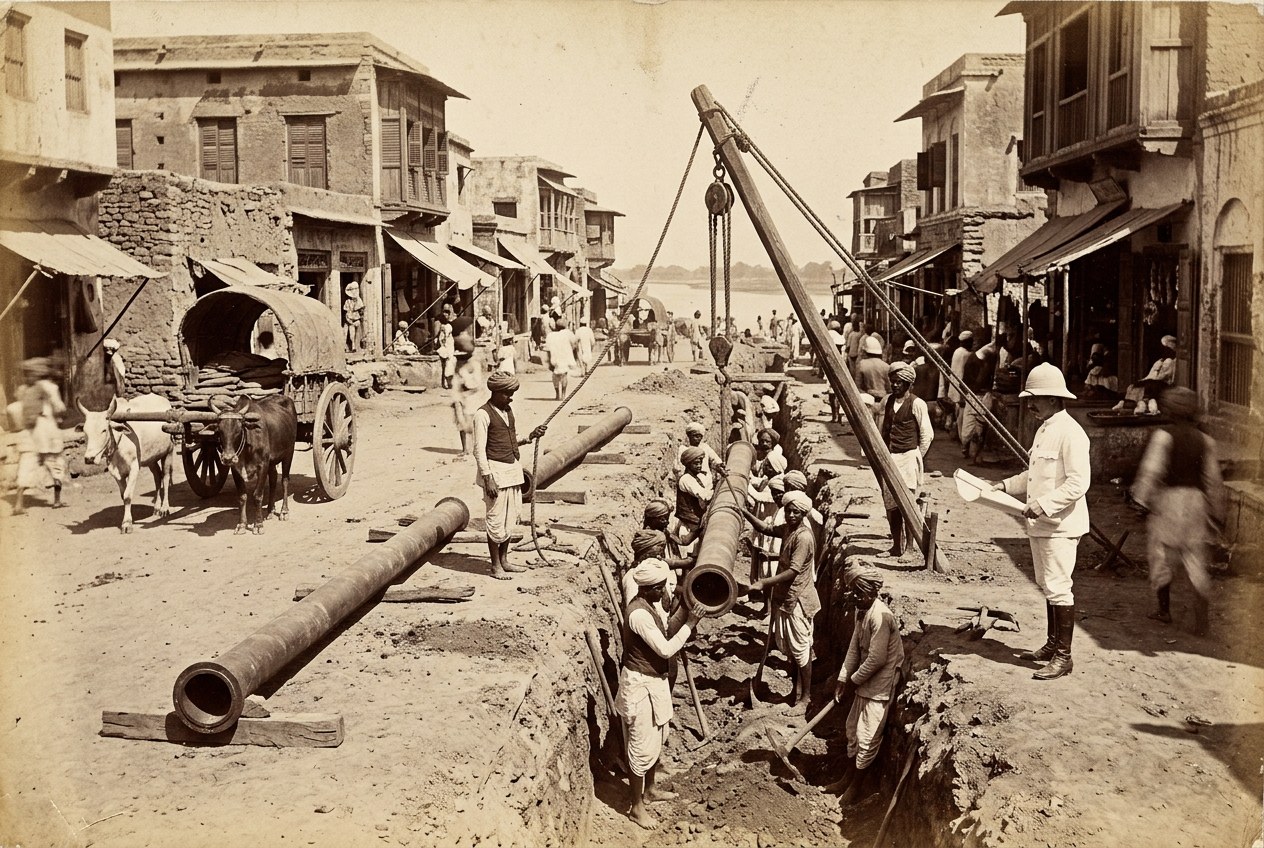
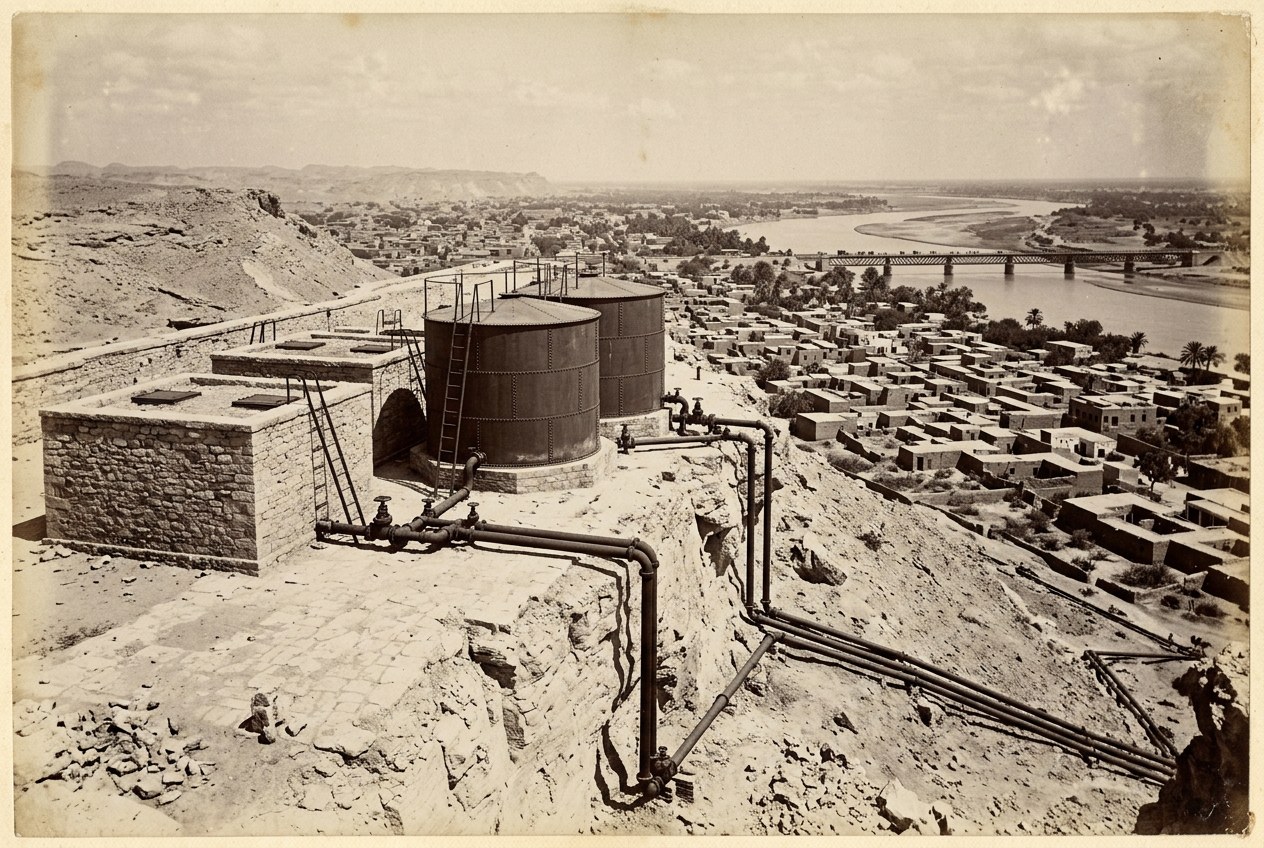
From the pump house the water went uphill. Not to a tower, but to the top of the ridge above the town, which the gazetteer calls the “high hill known as Edinburgh Castle”. Two masonry reservoirs were built there, with two iron tanks above them. The iron tanks were a separate service for the houses on the hill itself; the masonry reservoirs fed the town through what the gazetteer calls “an extensive system of pipes”.
The arrangement is a classic gravity scheme. Pumps do the work once, lifting water to the highest point available, and gravity does the rest. Every metre of height above the bazaar became pressure at the tap. It also meant that the hill houses, already higher than the reservoirs’ own head, needed their own tanks to get any pressure at all, which is why there were four structures and not two.
What it cost, and who paid for it
The works cost Rs 3,44,638 in the first instance. To put that in perspective, Sukkur municipality’s total receipts in 1895-96 were Rs 1,15,113 and its expenditure Rs 1,18,310. The water works cost roughly three times the corporation’s entire annual income.
It was not the end of the spending. The following year a further Rs 29,096 went on extending the collecting galleries, because the supply fell short whenever the river was low. That fixed the worst of it, but the gazetteer admits the supply “could be improved with advantage”, and notes that government had approved an improvement scheme costing four and a quarter lakh of rupees which had still not been started.
The money came from the usual municipal sources. Until 1915 the corporation lived on octroi, the toll on goods entering the town, which produced about half its income; in 1916 a terminal tax replaced it. A second steady earner was Bandar Fees, about Rs 31,994 a year, levied on goods landed or shipped at the wharf between the Sukkur Canal Regulator bridge and No. 1 Municipal Pillar, at three pies a maund coming in and one pie going out.
Householders paid by the size of their pipe, which is a neat Victorian compromise between a flat rate and a meter:
| Connection | Monthly charge, 1907 |
|---|---|
| Half-inch pipe | Re 1 |
| Three-quarter-inch pipe | Rs 2 |
| One-inch pipe | Rs 4 |
| Any of the above, from the high service reservoir | Half as much again |
| Trade, building and garden supply | Charged by measure |
The logic is easy to see. A wider pipe passes more water, so a wider pipe pays more. It required no meter, no reader and no argument, and it explains why so many old Sindhi houses had remarkably thin service connections.
What the water did to the town
The gazetteer gives one of the loveliest side-effects in a single clause. Describing the bare, quarried limestone around the civil station, it says that “a certain amount of vegetation is possible, thanks to the water works, and a few gardens are visible”.
That is what a reliable supply does first: it makes trees possible. After that come the things municipalities actually budget for. The corporation maintained three markets, two in New Sukkur and one in Old Sukkur, and five small gardens, and by 1916 its heaviest single expense was conservancy, with education second and the water works close behind. A town with piped water and a conservancy department is a different kind of town from one without: it can plan streets, drain them, and keep them passable.
None of this made Sukkur healthy overnight. The plague of 1897 emptied the treasury, and the gazetteer’s municipal chapter is a long complaint about deficits. But the direction of travel is clear. By the time the gazetteer was compiled, in 1907, Sukkur had a supply that most Indian cities of its size did not: filtered, pumped, stored and piped, with a tariff printed in the municipal accounts.
The 1941 reservoir on the Bukkur side
The second half of this story is a stone with a date on it.
A plaque on a municipal reservoir records 6 January 1941. The reservoir belongs to the generation of works built after the Sukkur Barrage opened in 1932. The barrage changed the river the 1895 engineers had designed for: it held the water level steadier, kept the channel deeper, and made it possible to plan abstraction on a river that no longer dropped quite so far in winter. It also changed the town, which grew through the 1930s on barrage revenue and wartime traffic.
A service reservoir built in 1941 makes complete sense in that setting. More houses, higher demand, and a need to hold water nearer the consumer so that the hill reservoirs did not have to do all the work. The name “Bukkur” points to the island and the old town quarter facing it, the part of Sukkur that the 1895 mains reached last.
For a long time the plaque itself was the missing piece: no published source carried its wording. A photograph of the stone now closes that gap, and the text below is transcribed from it, line by line.
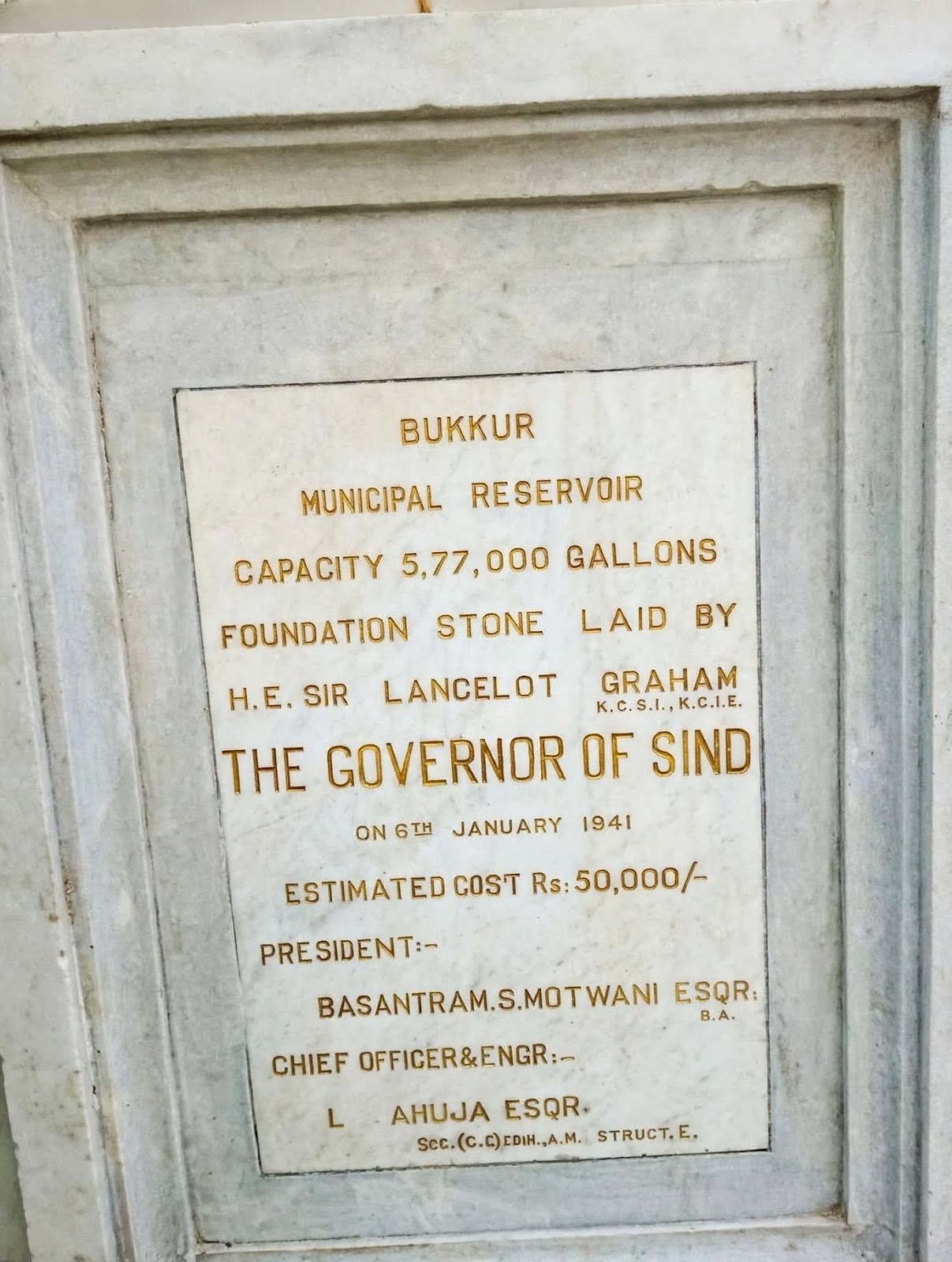
What the plaque says
| Inscription, Bukkur Municipal Reservoir, 6 January 1941 | |
|---|---|
| Building | Bukkur Municipal Reservoir |
| Capacity | 5,77,000 gallons |
| Foundation stone laid by | H.E. Sir Lancelot Graham, K.C.S.I., K.C.I.E., the Governor of Sind |
| Date | 6th January 1941 |
| Estimated cost | Rs 50,000 |
| President | Basantram S. Motwani, Esqr., B.A. |
| Chief Officer and Engineer | L. H. Ahuja, Esqr., Sec. (C.C.) Edin., A.M. Struct. E. |
Three details are worth slowing down for. The capacity, 5,77,000 gallons, is written in the Indian lakh grouping rather than as 577,000, which dates the text as surely as the year does. The cost, Rs 50,000, is about a seventh of what the 1895 works cost at first — a second-generation reservoir built for a fraction of the original scheme. And the stone names the two municipal officers who ran the job, President Basantram S. Motwani and Chief Officer and Engineer L. H. Ahuja, which is more than most water works of the period did for their engineers.
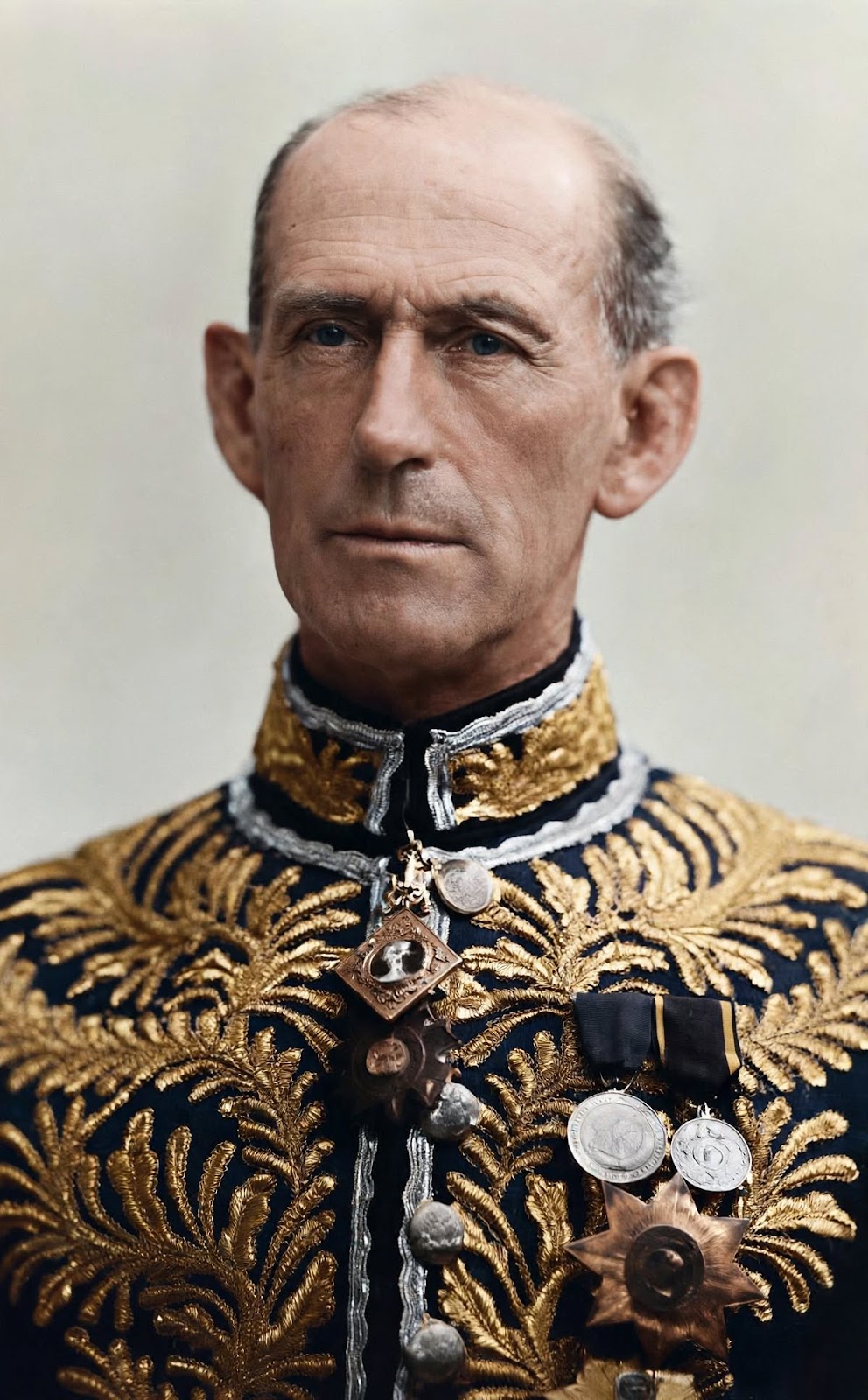
Sir Lancelot Graham was the first Governor of Sind, in office from 1 April 1936. He laid this stone on 6 January 1941, less than three months before his term ended on 31 March 1941 — one of the last public works of his governorship.


Still unrecorded
- The date the reservoir actually entered service, as opposed to the date on the stone.
- Whether the 5,77,000-gallon capacity was ever enlarged.
- The Urdu or Sindhi wording, if a second plaque on the site carries any.
- The contractor, who is not named on the stone.
From Bunder Road to the SWSC
The 1895 works were built on Bunder Road, and Bunder Road is still where Sukkur’s water is talked about. In 2021 a Tribune report on the city’s water crisis quoted the officer in charge of the Bunder Road water works by name, which tells you the site has never stopped being the reference point for the system.
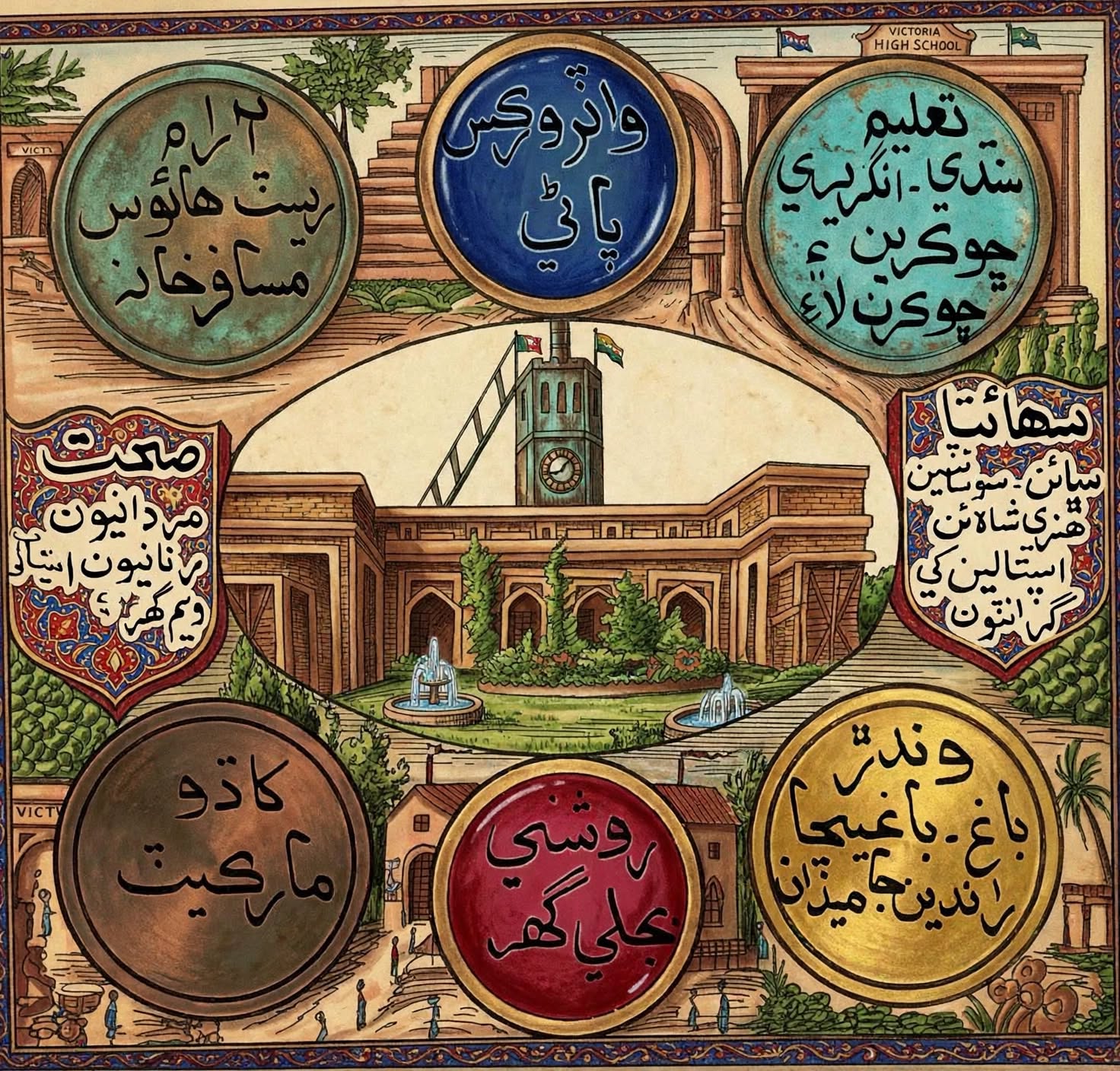
The institution around it has changed. Sukkur’s water and sewerage functions passed to the municipal corporation and, under the province-wide water and sewerage framework, to the Sukkur Water and Sewerage Corporation, created by an act of 2023. A rehabilitation and development of the distribution system is now planned under the Sindh public-private partnership unit, described as a 41 million gallon a day scheme.
Forty-one million gallons a day is a long way from a fifteen-inch pipe and two iron tanks. But the principle has not changed. Sukkur still takes its water from the Indus through the bank, still lifts it, still stores it high, and still argues about who pays.
The same idea, still working
Bank filtration did not stay in Sindh. Utilities in Germany, Hungary and the Netherlands draw a large share of their drinking water this way, and so do river cities in the United States, on the Ohio and the Missouri. The reasoning is the one the Sukkur engineers used in 1894: the river is not the source, the bank is.
Modern practice adds monitoring, modelling and a legal framework that the Victorians did not have. The trade-off has not changed. A gallery under a riverbed costs more to build than an intake pipe and less to run than a filtration plant, because the ground performs the first stage of treatment for nothing. That is why the technique keeps returning wherever a city sits on a muddy river with a porous bank.
Seen from the 2020s, the strangest thing about the 1895 scheme is which part aged best. The steam engines went, the iron tanks went, the fifteen-inch main was replaced. The decision to take the bank instead of the river is the one engineers would still defend.
Timeline
| Year | Event |
|---|---|
| 1856 | Sukkur’s municipal corporation dates its foundation to this year |
| 1878 | Bombay Act VI of 1873 extended to Sindh; Sukkur becomes a city municipality |
| 1884 | Elective principle introduced in the municipality |
| 1889 | Lansdowne Bridge opened across the Indus gorge |
| February 1894 | Water works begun |
| End of 1895 | Works opened; town supply begins |
| 1896 | Rs 29,096 spent extending the collecting galleries |
| 1897 | Plague outbreak damages municipal finances |
| 1907 | District gazetteer describes the works in detail |
| 1932 | Sukkur Barrage opens, changing the river and the town |
| 6 January 1941 | Date on the Bukkur municipal reservoir plaque |
| 2023 | Sukkur Water and Sewerage Corporation established |
Visiting: the Bunder Road works, the bridge and the 1941 reservoir
The pumping site is on the Sukkur bank of the river below the Lansdowne Bridge, reached from Bunder Road, the road that runs along the river front through the old commercial quarter. The bridge itself is best seen from the Old Sukkur (Chhapri) side or from the Rohri bank. The hill reservoirs stood on the ridge above the town, near the civil station and the roads that now carry the same names.
| What to see | Where | What to expect |
|---|---|---|
| Lansdowne Bridge | Across the gorge between Sukkur and Rohri | Open to traffic; best photographed from the Chhapri side or the Rohri bank |
| Pumping site | Sukkur bank below the bridge, off Bunder Road | A working water works, not a monument; no public tour |
| Bukkur Municipal Reservoir, 1941 | Near District Jail, Old Sukkur (Bukkur) | Seven-arched masonry structure, plaque on the wall; inside a compound, so ask at the gate |
| Hill reservoir site | Ridge above the town, “Edinburgh Castle” in the 1907 gazetteer | No signed remains; the value is the view and the layout, not a building |
| The town the pipes served | Bunder Road, Chhapri Bazaar, Ghanta Ghar | The commercial quarter, walkable in an hour |
October to March is the sensible window. From May to August the temperature passes 45°C and the river front gives no shade, which is exactly why the 1895 scheme was worth building. Early morning is the best light for the bridge and the least traffic on Bunder Road.
Nothing here is a museum. The water works is a working site, the bridge carries traffic, and the reservoir is somebody’s infrastructure. Go to look, not to climb, and ask before photographing staff or the inside of a compound.
Continue reading
The river is the thread through most of this site. Start with the surveys and designers behind the Lansdowne Bridge, then the engineering of the bridge itself. For the town the water served, see the Bunder Road parks, Ghanta Ghar, and the first hospitals of Sukkur. For the next piece of infrastructure in the sequence, the first power house of 1922 is the natural companion: electricity arrived twenty-seven years after piped water.
Two other threads run alongside this one. The first is public health: the cholera and plague years of 1869 to 1897 are the reason a water works was politically possible at all. The second is local government: the Deputy Commissioner’s office of 1901, the municipal corporation and its ruined finances explain how a town this size paid for anything. For the commercial world the pipes served, see Tilsi Market and the Parsi firms of Sukkur.
When did Sukkur get piped water?
The municipal water works were begun in February 1894 and opened at the end of 1895. Water came from wells and collecting galleries in the Indus bank, was pumped to reservoirs on the hill, and reached the town through iron mains.
Why did the engineers not take water straight from the Indus?
Silt. The river carries a heavy suspended load and would have clogged the slow sand filters of the period. Sinking wells in the bank and running galleries under the riverbed let sand and gravel do the filtering, which is what engineers now call riverbank filtration.
What did the water works cost?
Rs 3,44,638 at first, plus Rs 29,096 the following year to extend the galleries. That was roughly three times the municipality’s entire annual income in the year the works opened.
Where were the reservoirs?
On the high hill above the town, called Edinburgh Castle in the 1907 gazetteer: two masonry reservoirs for the town service and two iron tanks for the houses on the hill.
What is the 1941 Bukkur reservoir?
A municipal reservoir on the Bukkur side whose plaque is dated 6 January 1941. The photographed inscription records a capacity of 5,77,000 gallons and an estimated cost of Rs 50,000, laid by Sir Lancelot Graham, Governor of Sind, and names President Basantram S. Motwani and Chief Officer and Engineer L. H. Ahuja.
Does the 1895 system still exist?
The site on Bunder Road is still the city’s water works, but the 1895 plant has been replaced many times over. Sukkur’s supply is now managed by the Sukkur Water and Sewerage Corporation, with a distribution rehabilitation scheme planned.
Who built Sukkur’s water works?
The 1907 gazetteer describes the works in detail but does not name a designer, which is normal for municipal engineering in British India: the executive engineer and the municipal chief officer signed the accounts, not the drawings. The 1941 plaque is unusual because it does name its officers, President Basantram S. Motwani and Chief Officer and Engineer L. H. Ahuja.
Why is the 1941 reservoir called Bukkur?
Bukkur is the older name, for the island and the quarter facing it, and it stayed on the stone after the town on the opposite bank had settled into the name Sukkur. The plaque therefore records two things at once: a date and a place-name that official maps were beginning to drop.
Can you visit the Bukkur reservoir?
It stands near District Jail in Old Sukkur (Bukkur) and is visible from the road. It is not a ticketed monument and sits inside a working compound, so ask at the gate before walking in or photographing.
Sources
Primary printed sources
- Gazetteer of the Province of Sind, Volume III: Sukkur District (1907), Sukkur town, pp. 56-58, and the Local and Municipal chapter with Table XXVIII. The description of the works, the costs, the pipe sizes and the water rates all come from this text. Also available as a scanned copy at the Internet Archive.
- J. W. Smyth, Gazetteer of the Province of Sindh, Volume III: Sukkur District (1919), which reprints the water works account and shows the municipality’s continuing difficulty in paying for it.
Local history: oral and printed
- Ramchand Thatomal Ramnani, Rohri Yaadgar (Sindhi). A copy is held at the Indian Institute of Sindhology; it is the printed text most often quoted for the old quarters and their institutions.
- Parasram Verumal Masand, Sukkur Sonharo (Sukkur, 1940, Sindhi). Not digitised; cited from local collections.
- Rahimdad Khan Molai Shedai, Tarikh-e-Sukkur (Sindhi Adabi Board, Jamshoro; later editions). Not digitised; the standard municipal and biographical frame for the town.
- Syed Imdad Hussain Shah Rizvi, Rohri and Kotai: oral-history collection and family papers. Used here for the social record of water carrying and the old quarters. Oral testimony is not relied on for dates or figures.
Official and press
- “Parched on the banks of the Indus”, The Express Tribune, 3 October 2021, for the present state of the Bunder Road works.
- Sukkur Water and Sewerage Corporation Act, 2023, Government of Sindh; also on the Sindh Code.
- Rehabilitation and development of the water distribution system in Sukkur, Public-Private Partnership Unit, Government of Sindh; and the Sukkur Water and Sewerage Corporation itself.
Technical background
- Infiltration gallery and slow sand filter, for the two techniques combined in the 1895 design.
- Lansdowne Bridge, for the gorge at which the main well was sunk.
Image note: the plaque, the reservoir, the three portraits and the Bunder Road poster are photographic or printed sources, digitally restored for legibility. Restoration can change tone and fine detail, so the plaque wording above is transcribed from the stone itself. The pump house, mains and hill-reservoir scenes are illustrations drawn from the gazetteer’s description and are labelled as such. The supply diagram is a schematic, not a survey.
Frequently Asked Questions
When did Sukkur get piped water?
The municipal water works were begun in February 1894 and opened at the end of 1895. Water came from wells and collecting galleries in the Indus bank, was pumped to reservoirs on the hill, and reached the town through iron mains.
Why did the engineers not take water straight from the Indus?
Silt. The river carries a heavy suspended load and would have clogged the slow sand filters of the period. Sinking wells in the bank and running galleries under the riverbed let sand and gravel do the filtering, which is what engineers now call riverbank filtration.
What did the water works cost?
Rs 3,44,638 at first, plus Rs 29,096 the following year to extend the galleries. That was roughly three times the municipality’s entire annual income in the year the works opened.
Where were the reservoirs?
On the high hill above the town, called Edinburgh Castle in the 1907 gazetteer: two masonry reservoirs for the town service and two iron tanks for the houses on the hill.
What is the 1941 Bukkur reservoir?
A municipal reservoir on the Bukkur side whose plaque is dated 6 January 1941. The photographed inscription records a capacity of 5,77,000 gallons and an estimated cost of Rs 50,000, laid by Sir Lancelot Graham, Governor of Sind, and names President Basantram S. Motwani and Chief Officer and Engineer L. H. Ahuja.
Does the 1895 system still exist?
The site on Bunder Road is still the city’s water works, but the 1895 plant has been replaced many times over. Sukkur’s supply is now managed by the Sukkur Water and Sewerage Corporation, with a distribution rehabilitation scheme planned.
Who built Sukkur’s water works?
The 1907 gazetteer describes the works in detail but does not name a designer, which is normal for municipal engineering in British India: the executive engineer and the municipal chief officer signed the accounts, not the drawings. The 1941 plaque is unusual because it does name its officers, President Basantram S. Motwani and Chief Officer and Engineer L. H. Ahuja.
Why is the 1941 reservoir called Bukkur?
Bukkur is the older name, for the island and the quarter facing it, and it stayed on the stone after the town on the opposite bank had settled into the name Sukkur. The plaque therefore records two things at once: a date and a place-name that official maps were beginning to drop.
Can you visit the Bukkur reservoir?
It stands near District Jail in Old Sukkur (Bukkur) and is visible from the road. It is not a ticketed monument and sits inside a working compound, so ask at the gate before walking in or photographing.

Leave a Reply