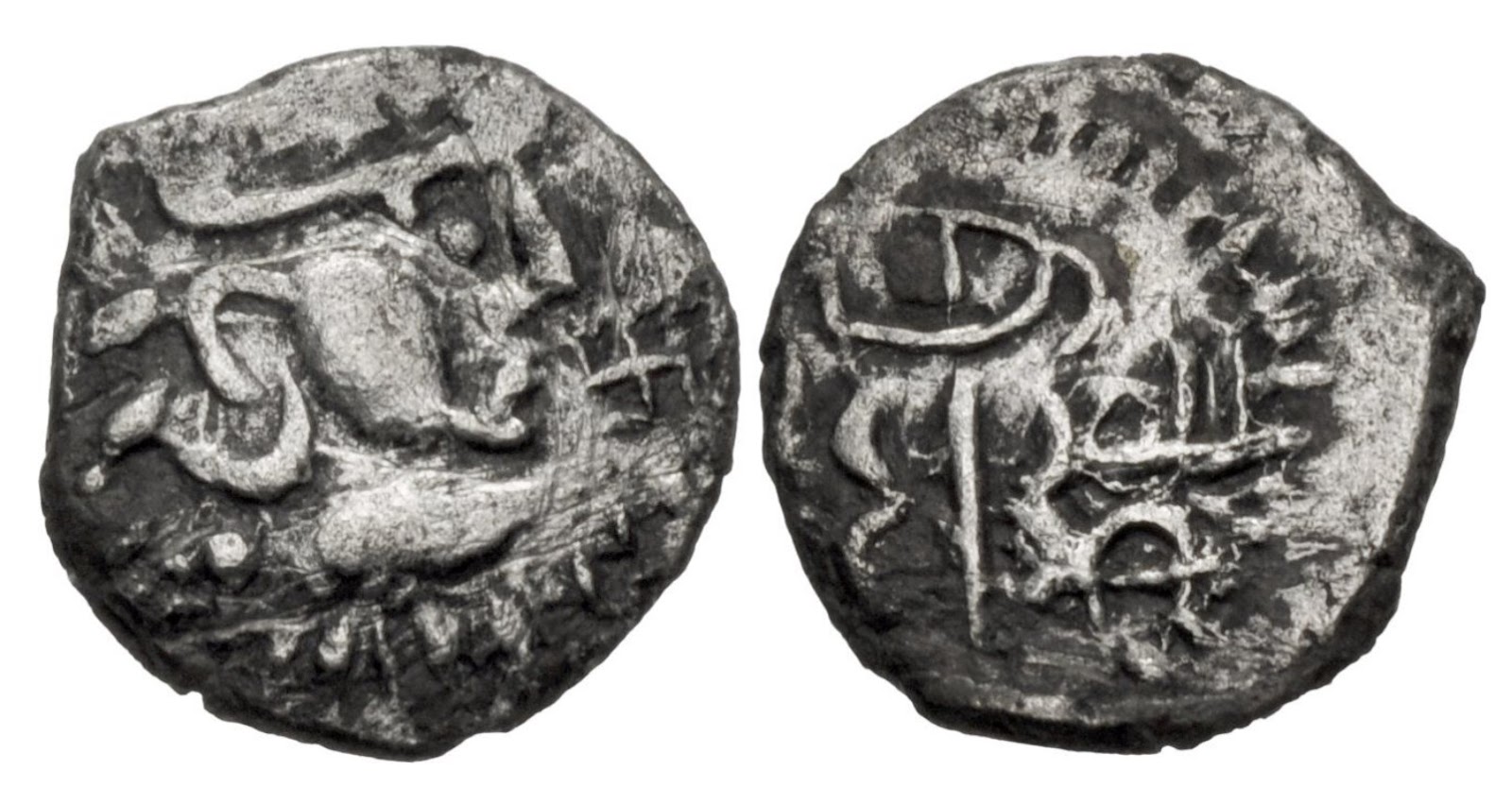
A coin the width of a fingernail, struck in silver, sits in the palm: on one face a crowned head in profile, a swastika before it; on the other a trident with letters curling around it in Brahmi. It weighs less than a gram. It was made somewhere on the lower Indus about thirteen hundred years ago, and it is one of the few objects from that world that still speaks in its own words.
Sindh’s coins are the least-read archive of the region. They record who ruled, which languages were in use, what trade reached the Indus and what a day’s shopping cost. This guide follows that record from the first punch-marked silver to the rupee of British India, and explains where the coins were found, how to read them, and where they can still be seen.
Published by Rohri.net
| Sindh’s coinages at a glance | |
|---|---|
| Punch-marked silver | c. 6th–2nd century BCE; irregular silver, symbols only, no names |
| Indo-Greek and Indo-Parthian | c. 2nd century BCE–1st century CE; silver, Greek and Kharosthi |
| Kushan | c. 1st–3rd century CE; gold dinars and heavy copper |
| Sasanian | c. 3rd–5th century CE; thin silver drachms, fire altars |
| Brahmin dammas | c. 632–712 CE; silver, 10–12 mm, 0.6–0.9 g, trident and Brahmi |
| Arab governors and Habbaris | 712–1024 CE; silver dammas with Kufic Arabic |
| Brahmanabad copper | c. 8th–11th century CE; thick, cast copper flans of the Mansura type |
| Mughal rupees | 16th–18th century; silver rupee from the Bhakkar mint |
| British rupee | 1843 onward; uniform colonial coinage |
Why Sindh produced so many different currencies
Sindh sits where the Indus meets the sea and where the overland roads from Central Asia meet the maritime routes to the Persian Gulf. Every power that wanted that corridor — Mauryan, Greek, Parthian, Kushan, Sasanian, Arab, Mughal, British — brought its money with it, and local rulers struck their own alongside it. The result is a sequence of coinages unusual for its density: a small region with an almost continuous monetary record from the middle of the first millennium BCE to the twentieth century.
The physical setting matters as much as the politics. Sindh is a land of tells, the mounds of mud brick that mark abandoned cities, and its coins were lost in the street, buried in hoards during raids, or dropped into drains that later filled. Henry Cousens, surveying for the Archaeological Survey of India, noted how readily the old mounds give up their contents; a century later, farmers and treasure hunters still find them. That abundance is why the numismatics of Sindh can be reconstructed at all — and why the ethics of how the coins leave the ground matter so much.
Before coinage carried names: the punch-marked silver
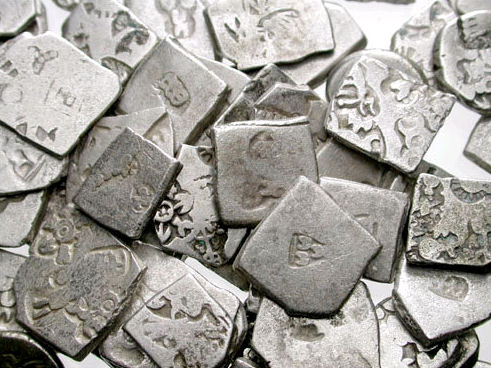
The oldest coins found in the region are not Sindhi in origin. They are the punch-marked silver of the Gangetic plains, struck from roughly the sixth century BCE and still circulating when the Mauryans held the Indus in the third century BCE. The method was simple: a blank strip of silver was cut to weight, then struck with several punches at once, so that each coin carries a scatter of symbols — a sun, a hill with a bull on it, a six-armed mark, a tree in a railing.
What those coins do not carry is a name. There is no king on them, no date, no mint. The symbols are the only text, and their meaning is still argued over. For a modern reader the lesson is worth stating plainly: the earliest money in this part of the world was guaranteed by weight and by the reputation of the issuer, not by a portrait or a legend.
The Greeks, the Parthians and the Kushans
Alexander’s successors in Bactria pushed south into Gandhara and the Punjab, and by the second century BCE Greek kings held territory that touched the Indus. Their coins are among the most informative ever struck in the region, because they are bilingual: a royal portrait and a Greek legend on one face, and a Kharosthi legend on the other, so that a Greek official and a local trader could each read the same coin. The finest silver of Menander I and Eucratides travelled far beyond their kingdoms and circulated into Sindh.
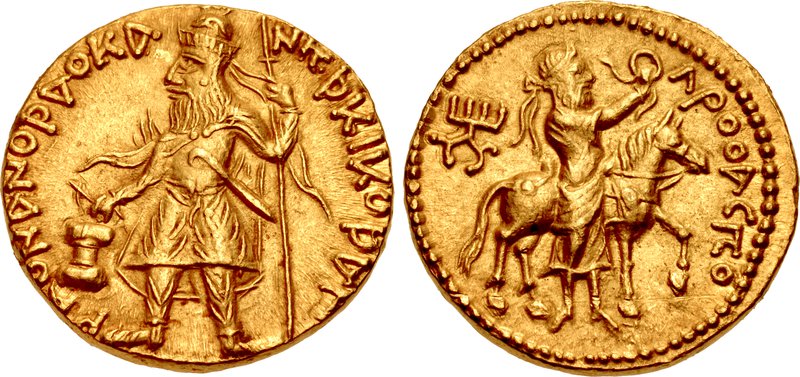
They were followed by the Indo-Parthians, whose king Gondophares is remembered in both Indian and Christian tradition, and then by the Kushans, whose empire ran from Afghanistan to the Gangetic plain. The Kushans struck gold: dinars of high purity showing the king standing at a fire altar on one side and a deity on the other, with titles in Greek script that had by then become a ceremonial language. A single Kushan dinar was worth a very large number of the small silver pieces that did the everyday work of commerce.
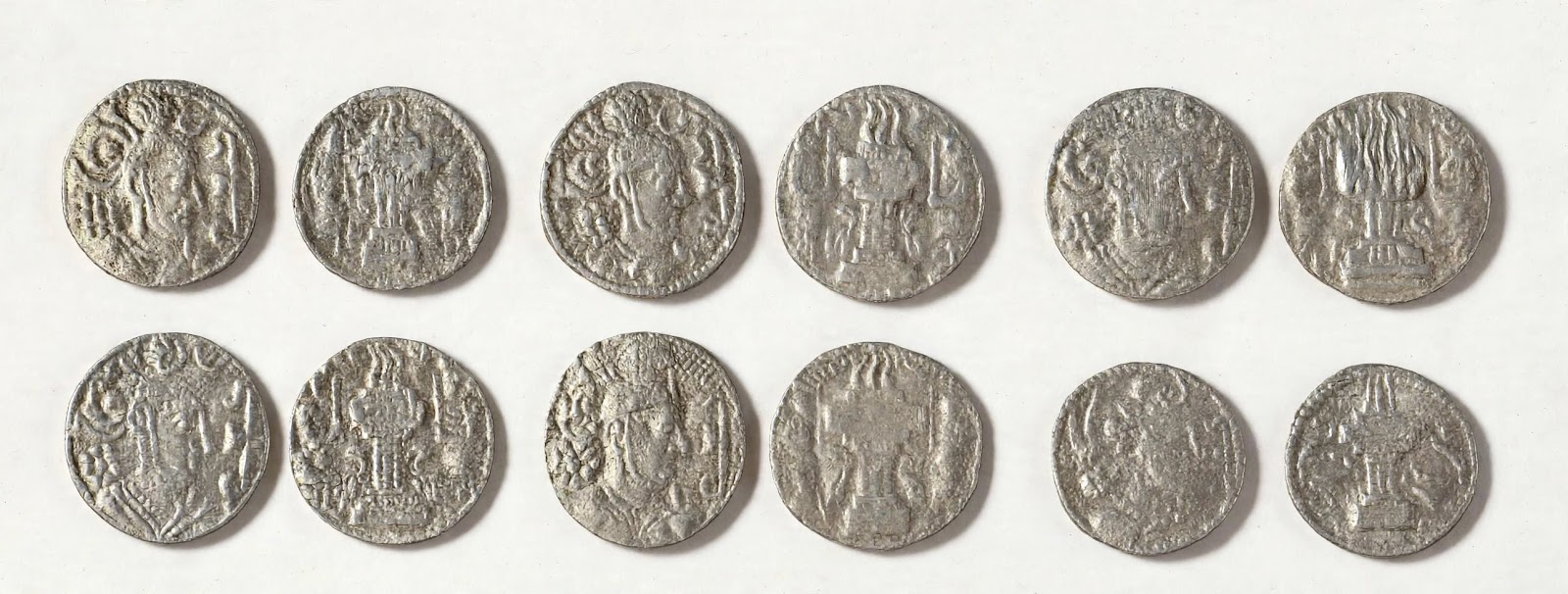
Behind all of them stood the Sasanian empire of Persia, whose thin silver drachms, with a crowned king on one face and a fire altar on the other, set the weight standard that local minters on the Indus later adopted. When the Brahmin kings of Sindh began to strike their own silver in the seventh century, the model in front of them was Persian. The politics behind that borrowing — the Brahmin kings of Aror, the last of them Raja Dahir, and the Arab conquest — are traced in Indus Epochs, Part 3: Rohri, Bukkur and Sukkur, 564–862 CE.
The dammas of the Brahmin kings
Between about 632 and 712 CE, Sindh was ruled by a dynasty of Brahmin kings whose capital was at Aror, near modern Rohri. The best known of them, Chach, is the subject of the Chachnama, the chronicle that describes his rise and the reign of his son Dahir before the Arab conquest. Their coins are the region’s first distinctly Sindhi money: small silver pieces known to collectors as dammas.
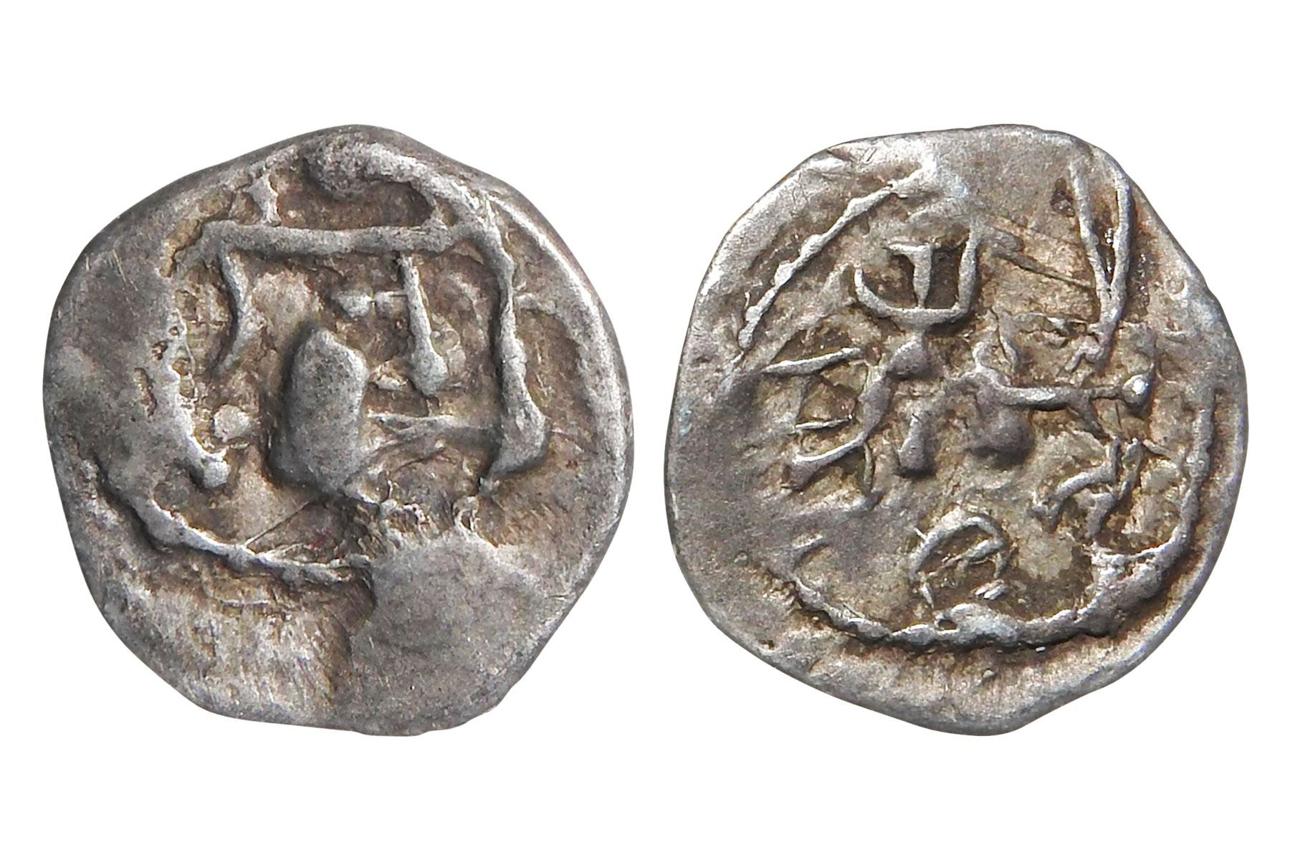
A typical example is barely 11 to 12 millimetres across and weighs between about 0.62 and 0.9 grams. The obverse carries a crowned bust facing right with a swastika in front of it. The reverse carries a large trident, the emblem of Shiva, surrounded by Brahmi letters that read Śri Yashaditya or Śri Pracandendra — titles rather than birth names, which is why numismatists speak of the “Yashaditya series” rather than of the coins of one king.
A related group, sometimes labelled Śri Tapana and dated to the last quarter of the seventh century, is slightly broader at about 12 millimetres and shows the Brahmi syllable Śri on the ruler’s forehead, with a fire altar surmounted by pellets on the reverse — a design lifted almost directly from Sasanian Persia.
One caution belongs here. The attribution of the Yashaditya series has moved over the past century: older catalogues placed some of these coins with Hunnic rulers, and the modern consensus, following the work of Fishman and Todd and later researchers, ties them to the Brahmin kings of Sindh and their successors. Dates in auction catalogues vary by decades for the same type. Anyone building a collection should treat the series as a family of related issues rather than a fixed royal sequence.
What a damma was worth
Numismatists describe the damma as one sixth of a dirham. That ratio explains the size: a dirham was itself a modest silver coin, and a sixth of one was small change — the price of bread, of a few vegetables, of a ferry crossing. Sindh’s economy ran on these tiny pieces, and the fact that they were struck in such numbers says something about how monetised daily life on the Indus had become by the seventh century.
The small size also explains why so few are found intact. A coin under a gram is easily lost, easily corroded, and easily overlooked; the pieces that survive are usually the ones that went into the ground in a hoard, buried in a hurry and never recovered by their owners.
After 712: Arab governors and the Habbari emirs
The campaign of Muhammad bin Qasim in 711–712 ended Brahmin rule and brought Sindh into the Umayyad caliphate. The coinage changed with the politics. Portraits and tridents gave way to Arabic calligraphy: the profession of faith, the name of the caliph, and the name of the governor who struck the coin. The weight standard, however, did not change overnight — early Arab issues in Sindh still look like dammas, because that is what people were used to using.
Among the governors, names such as Bishr bin Daud al-Muhallabi are known from silver dammas struck in the first half of the ninth century. Then, from the middle of that century until 1024, the Habbari dynasty ruled much of Sindh as a semi-independent emirate from Mansura, and their silver dammas became the standard currency of the region. They are plain, elegant coins: Kufic letters arranged in three or four lines, naming the emir and invoking God, with no image at all.
Those coins travelled. Habbari dammas turn up in hoards around the Arabian Sea and the Persian Gulf, which is the clearest evidence that Sindh’s ports were part of a maritime economy reaching Basra, Oman and beyond. A coin struck at Mansura could be spent in a market on the other side of the sea.
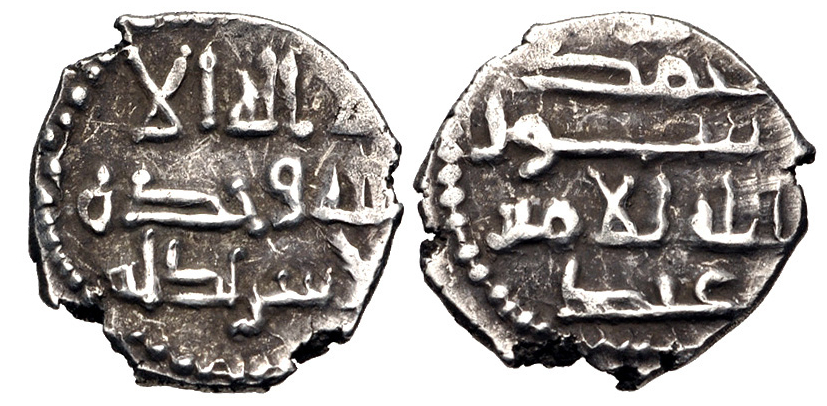
Brahmanabad coins: silver and copper currency of medieval Sindh
Brahmanabad was the seat of government in Sindh after the conquest of 712 and remained the administrative centre of the lower Indus until Mansura was founded a few miles away in the eighth century. The two cities are usually treated as one numismatic province, and so are their coins: a mixed currency of small silver dammas and a much cruder copper coinage that did the everyday work of the bazaar. For anyone following the history of Sindh’s money, this is the pivotal group, because it is where an Indian silver tradition meets an Islamic monetary system, and where the region’s copper coins become common enough to study as a series rather than as isolated finds.
Historical coinage of Brahmanabad
The site is a field of mounds in the lower Indus plain, identified by most archaeologists with the ruins near Shahdadpur, and its coins have been picked up, dug out and catalogued for more than a century. The silver is the same damma that circulated across Sindh — thin, hand-struck and under a gram — while the copper is heavier, thicker and far less elegant. Both were local money, made for a provincial capital whose trade ran downriver to the ports and overland towards Multan and the Punjab.
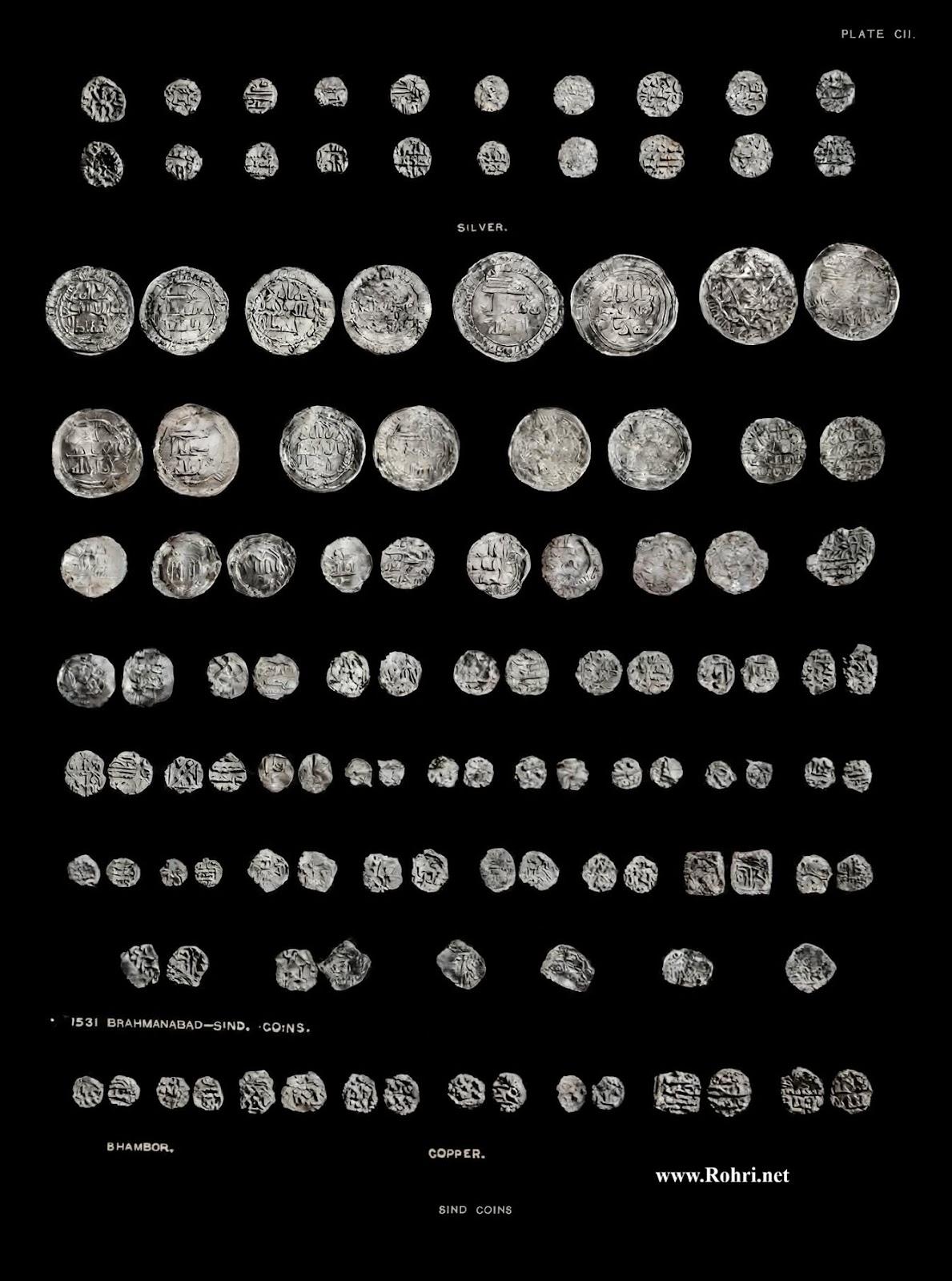
Silver coins and their inscriptions
The silver of this group belongs to the same Yashaditya family described above: a crowned bust with an auspicious symbol before it, and on the other face a trident or a fire altar surrounded by Brahmi letters. What changes at Brahmanabad is the company the silver keeps. In the same deposits appear Arab-Sindh dammas with Kufic legends, so that a single hoard can hold a coin struck for a Brahmin king and a coin struck for an Umayyad governor, sometimes within a generation of each other. That mixture is the clearest material evidence of how quickly the province changed hands and how slowly its money changed with it.
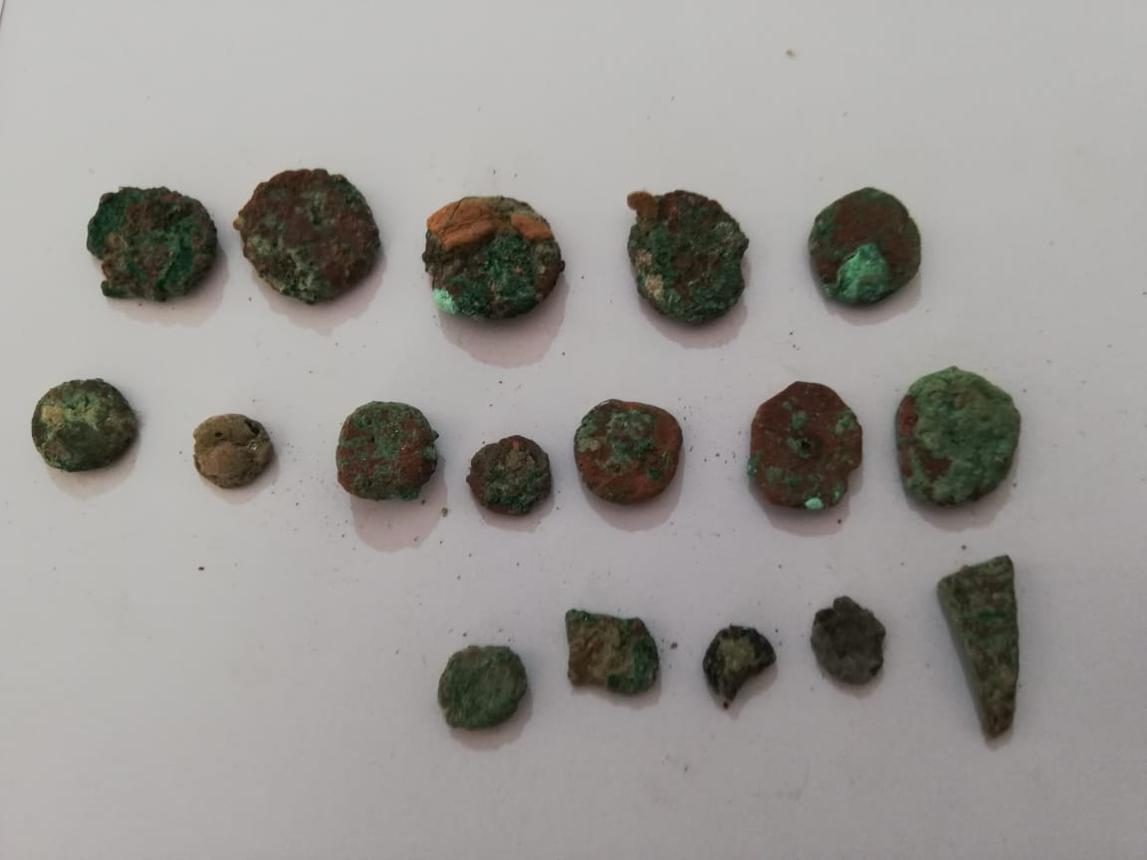
Copper currency in medieval Sindh
Copper is where the everyday economy survives. The pieces in the photograph above are small, thick and dumpy, roundish but never quite round: several are clipped, and a few still carry a spur or sprue from casting. That squat, irregular shape is not damage but manufacture, and it is exactly the profile Cousens recorded for the local Sind copper illustrated on Plate CII of The Antiquities of Sind — the Brahmanabad–Mansura type, sometimes also described from Bhambor. On most of these specimens the legend and the device are buried under corrosion; where the crust has broken, the metal underneath is a warm copper-brown.
The lesson for a reader is that copper coins are archaeological objects rather than display pieces. Their value lies in the group: weights, fabric, flan shape and the pattern of wear tell numismatists more than any single readable inscription, and a corroded lot like this one is a record of what circulated in a provincial market rather than a set of rarities.
Numismatic evidence for Sindh’s economic history
Brahmanabad’s coins matter because they show a monetised economy at several levels at once. Silver dammas handled ordinary purchases; copper handled the smallest ones; and the presence of both, in quantity, implies markets busy enough to need small change. The same deposits also contain imported material — carnelian, glass, occasional gold — which is the archaeological signature of a capital plugged into long-distance trade rather than a self-contained village. Put simply, the coins are the receipts of that trade.
Historical sources and coin references
Three kinds of source underpin this section. The first is the survey literature: Henry Cousens, The Antiquities of Sind (1929), whose plates remain the reference point for the copper type described here, and which is available in full on the Internet Archive. The second is the chronicle tradition, above all the Chachnama, which supplies the political frame for the seventh and eighth centuries. The third is the modern catalogue: museum and auction listings, Numista entries and the American Numismatic Society database, where individual types can be compared by weight and diameter.
A note on the label “1531”. Some photographs of this group circulate with the caption “1531 Brahmanabad-Sind. Coins.” That number should not be read as a date of minting. It belongs to an older plate, inventory or accession sequence, and the coins themselves carry no date at all. Before assigning a century or a ruler to any piece, check the plate number, the publication it came from and the die details; where the attribution cannot be verified, describe the coin as “Brahmanabad–Mansura type, date uncertain” rather than guess.
Image credit: Research & Documentation by Rohri.net — www.rohri.net. Photographs are reference images, not to scale with one another.
Reading a coin: what the symbols meant
| Device | Meaning and period |
|---|---|
| Punched symbols | Sun, hill, bull, six-armed mark — issuer’s marks on punch-marked silver, c. 6th–2nd century BCE |
| Greek and Kharosthi legends | Bilingual royal titles of the Indo-Greek kings, 2nd–1st century BCE |
| King at a fire altar | Kushan royal investiture imagery, 1st–3rd century CE |
| Fire altar with attendants | Sasanian Zoroastrian iconography, 3rd–5th century CE |
| Trident and swastika | Shaiva and auspicious emblems of the Brahmin kings of Sindh, 7th–8th century CE |
| Kufic Arabic | Shahada and the ruler’s name under the Arab governors and the Habbaris, 8th–11th century CE |
Where the coins are found: Aror, Vijnot and the old mounds
Cousens, surveying for the Archaeological Survey of India in the early twentieth century, recorded coin finds at the ruined cities of Upper Sindh. At Aror, the pre-Islamic capital on the old course of the Indus near Rohri, seasonal rain still washes corroded copper and silver pieces out of the mounds, along with the huge baked bricks of the pre-Arab city — some measuring about 18 by 12 by 4 inches.
At Vijnot, in Ubauro taluka of Ghotki district, excavations recorded a more varied assemblage: corroded copper coins roughly half an inch across weighing 30 to 40 grains, smaller fractions of 17 to 22 grains, and tiny silver pieces about three-tenths of an inch wide weighing only 6 or 7 grains, some bearing faint impressions of a human figure or a couple. The same deposits produced carnelian beads with white etched patterns, glass bangles, and gold ingots of up to about 11.5 ounces.
Those finds are the physical evidence behind the sequence described in this article, and they connect the coins to a wider trade in semi-precious stone and metal that ran through Sindh long before the barrage, the railway or the modern road. The archaeology of that trade is followed in the wider history of the eastern Nara canal and the buried settlement at Hakrah, where excavation exposed foundations ten feet deep, clay pipes and ancient pottery.
The long middle: Soomra, Samma and the Mughal rupee
After the Habbari emirs, Sindh passed through the Soomra and Samma dynasties and then into the orbit of the Delhi Sultanate and the Mughals. The coinage of this long period is less distinctive locally, because silver rupees of the imperial standard did most of the work. What matters for Sindh is the mint: Bhakkar, the island fortress on the Indus between Rohri and Sukkur, struck Mughal rupees in its own name.
Bhakkar was Bakhar to the older chroniclers, and the fort of Bakhar at Bukkur is the reason the mint existed. The stronghold stands on a rock in the Indus between Rohri and Sukkur, and the river, cutting a new channel, turned that rock into an island — a change Cousens records in The Antiquities of Sind, and the reason the position could be held with a small garrison while commanding the whole river. Everything moving up and down the Indus passed beneath those walls, which is precisely the traffic a mint is built to tax and to coin.
Rupees of Akbar dated to the 980s AH carry the Bhakkar mint name, and the mint continued under Shah Jahan and Muhammad Shah. Later, in the eighteenth century, transitional silver was struck in Sindh in the name of Mahmud Shah Durrani, and the East India Company’s Bombay Presidency issued rupees for the Sindh province before the annexation. For a collector, a Bhakkar rupee is the most direct way to own a piece of the town’s monetary history: the name on the coin is the name of the island in the river.
British Sindh and the end of local money
The conquest of Sindh in 1843 ended the region’s separate coinage. British India’s rupee, divided into sixteen annas, replaced the local issues, and for the next century the money in a Sukkur shop was the same as the money in Bombay. The older coins did not disappear, though. They stayed in the ground, in family hoards, and in the curiosity cabinets of colonial officers — which is how many of them reached the museums where they are now studied.
Where to see the coins today
The State Bank of Pakistan Museum in Karachi is the most accessible place to see Arab-Sindh coinage in the country, and the Lahore Museum holds a large numismatic collection covering the full sequence from punch-marked silver onward. Abroad, the British Museum’s collection online and the American Numismatic Society’s database catalogue thousands of related Indian and Central Asian pieces, and the Habbari section of Numista is a practical identification aid with photographs and weights for individual types.
For the Sindhi series specifically, the single most useful older source remains Henry Cousens, The Antiquities of Sind (1929), which is available in full on the Internet Archive and includes the plates and survey notes from which many later descriptions still derive.
Collecting, law and ethics
Coins are the easiest antiquities to buy and the easiest to loot, and the two facts are connected. Under Pakistan’s Antiquities Act, 1975, ownership of all buried antiquities vests in the Federal Government, and the export of protected antiquities is prohibited. A coin dug up last month in Ghotki and offered online has almost certainly broken that law, and buying it funds the next hole in the next mound.
The alternative is provenance. Coins that left the region legally before 1975, or that come from old collections with a documented history, are traded openly by established dealers and auction houses and appear in museum catalogues. Those pieces are worth collecting, and they are the ones that carry a story rather than just a type. Coins should also never be cleaned aggressively: the patina is part of the object, and scrubbing a silver damma destroys both its surface and its value.
A rare silver Damma coin of Sri Yashaditya from the Chacha Dynasty of Sindh (c. 679–712 CE). The coin features a crowned ruler’s bust on the obverse and a large trident with the inscription Sri Yashaditya on the reverse, reflecting the political and religious heritage of early medieval Sindh before the Arab conquest.


The cast copper coin of Brahmanabad is an important artifact of Sindh’s numismatic heritage. It provides valuable evidence of local trade, economic exchange, and the development of currency in one of the most significant urban centers of ancient and medieval Sindh. Its study helps historians understand the region’s commercial networks and cultural history.
The Soomra Dynasty played a significant role in the political history of Sindh between the 11th and 14th centuries. However, current numismatic research has not conclusively demonstrated the existence of an official Soomra mint producing clearly identifiable coins in the rulers’ names. In contrast, the later Samma Dynasty is supported by stronger numismatic evidence, including copper tankas attributed to rulers such as Jam Nizam al-Din II and Jam Firoz. These coins remain important sources for understanding the monetary and political history of medieval Sindh.


Timeline
| Date | Coinage |
|---|---|
| c. 6th–2nd century BCE | Punch-marked silver circulates in the Indus region |
| c. 2nd–1st century BCE | Indo-Greek silver with Greek and Kharosthi legends |
| c. 1st–3rd century CE | Kushan gold dinars and copper; Sasanian drachms set the standard |
| c. 632–712 CE | Brahmin kings of Sindh strike silver dammas at Aror |
| 711–712 CE | Arab conquest; coin legends turn to Arabic |
| c. 854–1024 CE | Habbari emirs of Mansura issue silver dammas for regional and maritime trade |
| c. 8th–11th century CE | Brahmanabad and Mansura: silver dammas beside thick cast copper of the local Sind type |
| 16th–18th century | Mughal rupees struck at the Bhakkar mint |
| 1843 | British annexation; the rupee of British India replaces local coinage |
| 1975 | Antiquities Act; buried antiquities become state property |
Frequently Asked Questions
What was a damma in Sindh?
A damma was the small silver coin that circulated in Sindh from roughly the seventh to the eleventh century. It weighed about 0.6 to 0.9 grams and measured 10 to 12 millimetres across, and numismatists describe it as worth one sixth of a dirham. It was the everyday money of a region that used imperial coins only for large transactions.
What do the coins of Chach of Alor look like?
The Yashaditya series associated with the Brahmin rulers of Sindh shows a crowned bust facing right with a swastika or similar symbol in front, and on the reverse a large trident surrounded by Brahmi letters reading Sri Yashaditya or Sri Pracandendra. Survivors are silver, about 11 to 12 millimetres wide and 0.6 to 0.9 grams in weight.
Who minted coins in Sindh after the Arab conquest?
Arab governors appointed after Muhammad bin Qasim’s campaign of 711–712 struck silver dammas carrying Arabic inscriptions, and from the mid-ninth century the Habbari emirs of Mansura issued their own small silver dammas with Kufic legends naming the ruler. These circulated through the Arabian Sea and Persian Gulf trade.
Where have ancient coins been found in Upper Sindh?
Henry Cousens and the colonial gazetteers record finds at Aror, the pre-Islamic capital near Rohri, where rain exposes corroded copper and silver coins among the brick mounds, and at Vijnot in Ubauro taluka of Ghotki district, where copper and tiny silver coins were excavated with gold ingots, carnelian beads and glass bangles.
Can I buy ancient coins from Sindh?
Only with care. Under Pakistan’s Antiquities Act, 1975, buried antiquities are the property of the Federal Government and their export is prohibited. Coins with documented provenance that were legally exported before 1975 are collected internationally, but freshly dug or undocumented pieces should be reported rather than bought.
Where can I see coins of Sindh in a museum?
The State Bank of Pakistan Museum in Karachi displays Arab-Sindh coinage, the Lahore Museum has a large numismatic collection, and the British Museum and the Ashmolean hold related Indian series. Online, Numista and the American Numismatic Society’s database are the most practical identification tools.
What is the oldest coin found in Sindh?
The oldest coinage in the region is the punch-marked silver of the Gangetic plains, struck from about the sixth century BCE and circulating into the Mauryan period. These pieces carry punched symbols — suns, hills, bulls and the six-armed mark — rather than names or portraits.
Why are Sindhi coins so small?
Silver was scarce and values were low. A damma paid for a small daily purchase, so the coins were struck thin and tiny, often under a gram and barely a centimetre across. Larger transactions used imperial silver or gold, or weighed metal.
What are Brahmanabad coins?
Brahmanabad coins are the currency of the old capital of Sindh, a mixed group of small silver dammas and thick cast copper pieces. The silver follows the Yashaditya tradition — a bust and auspicious symbol on one face, a trident or fire altar with Brahmi letters on the other — while the copper is cruder, with squat irregular flans of the type Henry Cousens illustrated on Plate CII of The Antiquities of Sind as the Brahmanabad–Mansura series.
Is 1531 the date of the Brahmanabad coins?
No. The caption “1531 Brahmanabad-Sind. Coins” found with photographs of this group is a plate, inventory or accession number, not a year of minting. The coins themselves carry no date, and their attribution rests on fabric, weight and die details rather than on that number.
Continue reading
- Arnold Albert Musto: the engineer behind Sukkur Barrage and Bungalow No. 2
- Indus epochs: Rohri, Bukkur and Sukkur, part 5
- The eastern Nara canal: history and geography
- Rohri, Sindh: complete history, heritage sites and travel guide
Sources
- Henry Cousens, The Antiquities of Sind (1929), Internet Archive, for the survey of Aror and Vijnot, the coin finds, the Brahmanabad–Mansura copper type illustrated on Plate CII, the brick and artifact descriptions, and the account of the fort of Bakhar at Bukkur.
- Brahmin dynasty of Sindh, Wikipedia, for the chronology of Chach and his successors.
- Habbari Emirate, Wikipedia, for the dates of the dynasty and its rule at Mansura.
- Punch-marked coins, Wikipedia, for the chronology and symbolism of the earliest Indian silver.
- Habbari dynasty coins, Numista, for individual types, weights and diameters.
- American Numismatic Society collection database, for comparative cataloguing of Kushan, Indo-Greek and Indian series.
- Antiquities Act, 1975, Government of Pakistan, for the legal status of buried antiquities and export.
- Fishman and Todd, Virtual Numismatic Library catalogues of early Sindhi coins, for the Yashaditya series attributions.
Image note: the coin photographs are of genuine specimens from public collections and are reproduced from Wikimedia Commons under CC BY-SA licences, credited in each caption; the Brahmanabad copper group, the Yashaditya silver reference photograph and the Sasanian drachm group are documented by Rohri.net. They are not to scale with each other.
Frequently Asked Questions
What was a damma in Sindh?
A damma was the small silver coin that circulated in Sindh from roughly the seventh to the eleventh century. It weighed about 0.6–0.9 grams and measured 10–12 mm across, and numismatists describe it as worth one sixth of a dirham. It was the everyday money of a region that otherwise used imperial coins for large transactions.
What do the coins of Chach of Alor look like?
The Yashaditya series, associated with the Brahmin rulers of Sindh, shows a crowned bust facing right with a swastika or similar symbol in front, and on the reverse a large trident surrounded by Brahmi letters reading Sri Yashaditya or Sri Pracandendra. Survivors are silver, about 11–12 mm wide and 0.6–0.9 grams in weight.
Who minted coins in Sindh after the Arab conquest?
Arab governors appointed after Muhammad bin Qasim’s campaign of 711–712 struck silver dammas carrying Arabic inscriptions, and from the mid-ninth century the Habbari emirs of Mansura issued their own small silver dammas with Kufic legends naming the ruler. These circulated through the Arabian Sea and Persian Gulf trade.
Where have ancient coins been found in Upper Sindh?
Henry Cousens and the colonial gazetteers record finds at Aror, the pre-Islamic capital near Rohri, where rain exposes corroded copper and silver coins among the brick mounds, and at Vijnot in Ubauro taluka of Ghotki district, where copper and tiny silver coins were excavated with gold ingots, carnelian beads and glass bangles.
Can I buy ancient coins from Sindh?
Only with care. Under Pakistan’s Antiquities Act, 1975, buried antiquities are the property of the Federal Government and their export is prohibited. Coins with documented provenance that were legally exported before 1975 are collected internationally, but freshly dug or undocumented pieces should be reported rather than bought.
Where can I see coins of Sindh in a museum?
The State Bank of Pakistan Museum in Karachi holds a display of Arab-Sindh coinage, the Lahore Museum has a large numismatic collection, and the British Museum and the Ashmolean hold Sindhi and related Indian series. Online catalogues such as Numista and the American Numismatic Society’s database are useful for identification.
What is the oldest coin found in Sindh?
The oldest coinage in the region is the punch-marked silver of the Gangetic plains, struck from about the sixth century BCE and circulating into the Mauryan period. These rectangular silver pieces carry punched symbols — suns, hills, bulls and the six-armed mark — rather than names or portraits.
Why are Sindhi coins so small?
Silver was scarce and values were low. A damma represented a small daily purchase, so the coins were struck thin and tiny — often under a gram and barely a centimetre across. Larger transactions were settled with imperial silver or gold, or with weighed metal rather than coin.
What are Brahmanabad coins?
Brahmanabad coins are the currency of the old capital of Sindh: a mixed group of small silver dammas and thick cast copper pieces. The silver follows the Yashaditya tradition, with a bust and auspicious symbol on one face and a trident or fire altar with Brahmi letters on the other, while the copper is cruder, with squat irregular flans of the type Henry Cousens illustrated on Plate CII of The Antiquities of Sind as the Brahmanabad–Mansura series.
Is 1531 the date of the Brahmanabad coins?
No. The caption 1531 Brahmanabad-Sind. Coins, found with photographs of this group, is a plate, inventory or accession number rather than a year of minting. The coins carry no date, and their attribution rests on fabric, weight and die details.
Published by Rohri.net · Rohri, Sindh: Heritage, History & Travel Guide · Heritage Research • Historical Documentation • Travel Information · Rohri • Sukkur • Sindh • Pakistan · https://www.rohri.net
Leave a Reply